

Ceramic Rods
Product Selection & Technical Specifications
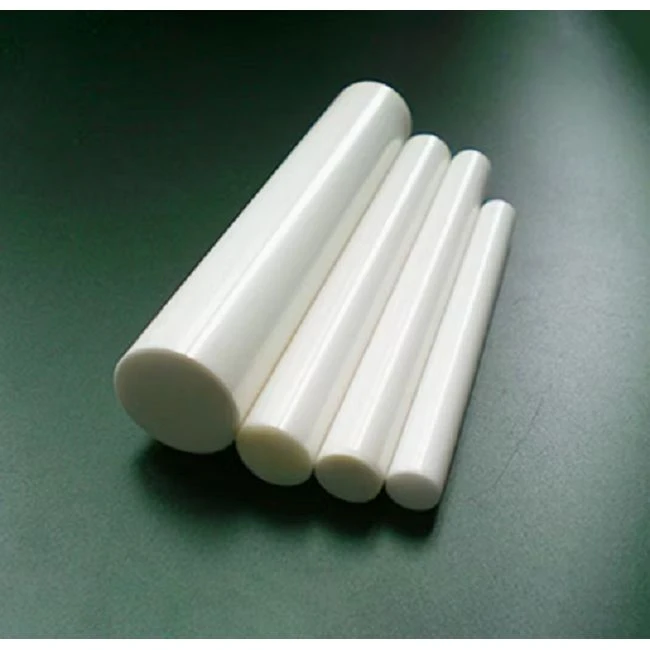
Standard stock profiles are available for rapid prototyping, alongside custom centerless grinding services for production-level tolerances.
Diameter Range
0.5 mm to 100 mm (as-fired or precision-ground).
Standard Lengths
Up to 500 mm (Alumina), up to 300 mm (Zirconia); custom cutting available.
Dimensional Tolerances
Centerless ground outer diameters achievable down to ± 0.01 mm. Straightness within 0.05 mm / 100 mm.
Surface Finish
Standard as-fired (Ra <= 1.6 um), fine-ground (Ra <= 0.4 um), or mirror-polished (Ra <= 0.1 um).
-
![Wear-Resistant Ceramic Rods]() Wear-Resistant Ceramic RodsIndustrial wear-resistant ceramic rods are engineered from high-purity alumina (Al2O3) and zirconia-toughened alumina (ZTA). Replacing conventional hardened steels and metal alloys, they provide...read more
Wear-Resistant Ceramic RodsIndustrial wear-resistant ceramic rods are engineered from high-purity alumina (Al2O3) and zirconia-toughened alumina (ZTA). Replacing conventional hardened steels and metal alloys, they provide...read more -
![Insulating Ceramic Rods]() Insulating Ceramic RodsWe manufacture custom and standard insulating ceramic rods utilizing high-purity engineering oxides. Material selection dictates thermal, mechanical, and electrical performance in demanding...read more
Insulating Ceramic RodsWe manufacture custom and standard insulating ceramic rods utilizing high-purity engineering oxides. Material selection dictates thermal, mechanical, and electrical performance in demanding...read more -
![Precision Ceramic Rods]() Precision Ceramic RodsPrecision ceramic rods serve as structural, wear-resistant, and thermally stable components in high-stress industrial applications. Standard stock materials include 95% to 99.8% Alumina (Al2O3),...read more
Precision Ceramic RodsPrecision ceramic rods serve as structural, wear-resistant, and thermally stable components in high-stress industrial applications. Standard stock materials include 95% to 99.8% Alumina (Al2O3),...read more -
![Silicon Nitride Ceramic Rods]() Silicon Nitride Ceramic RodsSilicon Nitride (Si3N4) outperforms traditional alumina and zirconia in applications requiring high fracture toughness paired with thermal shock resistance. Below are the baseline technical...read more
Silicon Nitride Ceramic RodsSilicon Nitride (Si3N4) outperforms traditional alumina and zirconia in applications requiring high fracture toughness paired with thermal shock resistance. Below are the baseline technical...read more -
![Zirconia Ceramic Rods]() Zirconia Ceramic RodsZirconia (ZrO2) provides the fracture toughness and wear resistance required for high-stress mechanical components. We specialize in Yttria-Stabilized Zirconia (Y-TZP) for structural reliability...read more
Zirconia Ceramic RodsZirconia (ZrO2) provides the fracture toughness and wear resistance required for high-stress mechanical components. We specialize in Yttria-Stabilized Zirconia (Y-TZP) for structural reliability...read more -
![Alumina Ceramic Rods]() Alumina Ceramic RodsAlumina (Al2O3) ceramic rods are dense, rigid structural components designed to withstand extreme thermal, electrical, and mechanical loads where conventional metals and polymers fail.read more
Alumina Ceramic RodsAlumina (Al2O3) ceramic rods are dense, rigid structural components designed to withstand extreme thermal, electrical, and mechanical loads where conventional metals and polymers fail.read more


Precision Technical Ceramic Rods: Engineering & Sourcing Guide
Product Judgment & Material Selection
When standard metals or plastics fail due to thermal degradation, electrical breakdown, or abrasive wear, technical ceramic rods provide structural integrity. Selecting the correct material grade determines the operational lifecycle of your assembly.
|
Material Grade |
Purity / Composition |
Key Mechanical & Thermal Properties |
Primary Use Case |
|
Alumina (Al2O3) |
95% - 99.5% |
High dielectric strength; Max temp up to 1600°C (99.5%); Moderate cost. |
Electrical insulators, furnace support pins, general wear parts. |
|
Zirconia (ZrO2) |
YTZP Stabilized |
Highest fracture toughness (KIC ~ 6-8 MPa·m1/2); High flexural strength (> 900 MPa). |
High-stress shafts, pump plungers, industrial cutting blades. |
|
Silicon Nitride (Si3N4) |
Hot Pressed / Sintered |
Exceptional thermal shock resistance; Low thermal expansion; Lightweight. |
High-speed bearings, welding pins, high-temperature structural components. |
Application Evaluation
Evaluate operating conditions before finalizing design drawings:
Thermal Shock
If thermal cycling exceeds 200°C/min, evaluate Silicon Nitride or toughened Zirconia over high-purity Alumina.
Load Bearing
Zirconia exhibits pseudo-elastic behavior under point loads, making it superior for cantilevered pins or structural rods exposed to impact.
Dielectric Requirements
99.8% Alumina is specified for high-frequency vacuum feedthroughs and high-voltage insulation rods where outgassing must be avoided.
Engineering validation relies on verifiable production capabilities rather than claims:
Forming Processes: Cold Isostatic Pressing (CIP) for dense, defect-free large rods; Dry Pressing for high-volume standard pins; Extrusion for high-aspect-ratio long rods.
Sintering Infrastructure: Gas-pressure sintering (GPS) and vacuum furnaces with programmed temperature profiles to eliminate internal micro-voids.
Machining & Finishing: In-house CNC green-machining followed by diamond wheel centerless grinding and laser outer-diameter inspection.
Quality Control & Testing:
Dimensional verification via 3D optical comparators and laser micrometer screening (100% inspection available for critical dimensions).
Material density verification via Archimedes water displacement method.
Batch Material Test Reports (MTRs) provided covering purity, density, and hardness.
Procurement Decision & RFQ Checklist
To accelerate your RFQ review and engineering evaluation, include the following parameters in your inquiry:
Exact 2D Drawing (PDF/CAD)
Specify critical functional dimensions, mating tolerances, and permissible runout.
Material Grade & Purity
State explicit ceramic composition (e.g., 99% Al2O3 or Y-TZP Zirconia) rather than generic terms.
Operating Environment
Define maximum working temperature, chemical exposure, mating materials, and mechanical load profile.
Quantity Profile
Detail prototype volume (e.g., 25 pcs) versus estimated annual usage (EAU) for tooling and volume pricing tiering.
Frequently Asked Questions

Technical Resources & Downloadable Assets
Access detailed material property matrices and testing criteria for your design review:
Download Comprehensive Technical Ceramics Material Property Datasheet (PDF) (Link placeholder)
Download ISO 9001 & Material Purity Testing Report Sample (PDF) (Link placeholder)
As one of the most professional ceramic rods manufacturers and suppliers in China, we also support customized service. Please rest assured to wholesale high quality ceramic rods in stock here from our factory. Contact us for more details.
ceramic insulating pin, Ceramic Sleeve Bushing, Ceramic Terminal Connector