

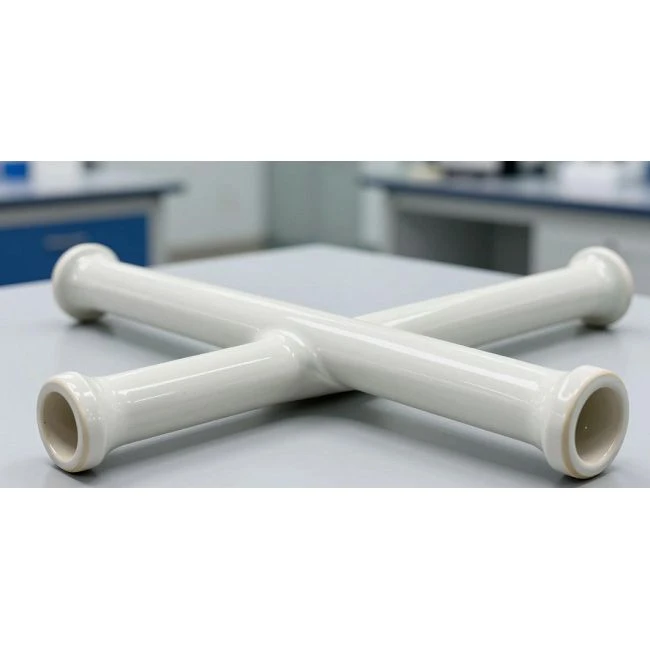
High-Purity Ceramic Thermocouple Protection Tubes for Extreme Thermal Environments
Engineered for high-temperature industrial furnaces, our ceramic protection tubes shield thermocouple elements from mechanical stress, corrosive process gases, and slag attack up to 1800°C. Built from dense, high-purity refractory oxides, these tubes prevent sensor drift and premature failure in aggressive thermal cycles.
Technical Specifications & Material Grades
Selecting the correct ceramic grade prevents catastrophic element failure and ensures accurate temperature readings.
|
Material Grade |
Purity (Al2O3 / Other) |
Max Operating Temp |
Gas Permeability |
Key Characteristics |
|
Alumina 99% (Al2O3) |
>= 99.3% (Low-silica options available) |
1700°C (3092°F) |
Gas-tight (Impermeable) |
Excellent chemical inertness, high hot-strength, resists alkali metal vapors. |
|
Recrystallized Alumina (RXA) |
>= 99.8% |
1800°C (3272°F) |
Gas-tight |
Superior resistance to thermal shock and reducing atmospheres. |
|
Mullite (3Al2O3 · 2SiO2) |
Phase-pure |
1500°C (2732°F) |
Low porosity |
Cost-effective for moderate temperatures, balanced thermal shock resistance. |
|
Silicon Carbide (SiC / RBSiC) |
Composite |
1650°C (3002°F) |
Dense / Sealed options |
Extreme mechanical wear resistance, high thermal conductivity. |
Standard Dimensions & Custom Tolerances
We grind outer and inner diameters to tight tolerances to ensure proper fit in standard protection assemblies.
Outer Diameter (OD): 6 mm to 50 mm (+/- 0.1 mm grinding tolerance available).
Inner Diameter (ID): 4 mm to 40 mm.
Length: Up to 2000 mm max in a single piece (longer lengths available via ceramic cementing or threading upon review).
Wall Thickness: Standard 2 mm to 5 mm; custom thin-wall profiles available for faster thermal response times.
Manufacturing & Quality Control Process
Powder Preparation: Spray-dried alumina powders with controlled binders ensure uniform green density and eliminate internal micro-voids.
Forming: Isostatic pressing for long tubes or extrusion for complex multi-bore profiles.
Sintering: Fired in high-temperature gas or electric tunnel kilns at temperatures exceeding 1650°C to achieve open porosity <= 0.1%.
Dimensional Finishing: Diamond grinding on outer surfaces guarantees precise outer diameters for tight thermal well fittings.
Quality Inspection:
- Dye penetrant inspection for surface micro-cracks.
- Helium mass spectrometer leak testing for gas-tightness verification.
- Dimensional coordinate measuring machine (CMM) verification on sample batches.
Application Suitability & Fit
Vacuum Heat Treatment Furnaces: Low outgassing rates at high vacuum levels protect heating elements and process loads.
Atmosphere Brazing Lines: Withstands reducing atmospheres containing cracked ammonia or high hydrogen without material degradation.
Aluminum Melting & Holding Furnaces: Resists non-ferrous metal splash and cryolite flux attack when coated or using high-purity alumina.
Waste Incineration & Boiler Flues: Withstands high-velocity fly ash erosion and sulfurous acid gas corrosion.
Frequently Asked Questions
Q: What is the maximum operating temperature for 99% Alumina tubes in continuous use?
A: 99% Alumina tubes maintain structural integrity up to 1700°C in continuous operation. For applications reaching 1800°C, Recrystallized Alumina (RXA) is recommended due to its refined grain structure and reduced creep at extreme heat.
Q: Are these tubes gas-tight (impermeable)?
A: Yes. Our 99% Alumina and RXA tubes are sintered to full density, rendering them completely gas-tight and impervious to hydrogen, carbon monoxide, and furnace combustion gases up to operating limits, preventing thermocouple wire poisoning.
Q: How do you prevent thermal shock cracking during furnace startup?
A: Thermal shock resistance depends on heating rates and wall thickness. We recommend preheating furnaces at a rate not exceeding 150°C per hour below 500°C. For rapid-cycling environments, we recommend specifying thinner wall profiles (e.g., 2 mm to 2.5 mm) to reduce thermal gradients.
Q: Can you manufacture custom lengths and multi-bore profiles?
A: Yes. We accept custom drawings for single-bore, dual-bore, and four-bore tubes. Maximum single-piece length is 2000 mm. For longer assemblies, precision-ground ceramic coupling joints are available.
Q: What documentation is supplied with a production batch?
A: Each shipment includes a Material Test Report (MTR) detailing chemical composition (purity percentage and trace element limits), bulk density, apparent porosity, and dimensional inspection results matching your PO specifications.
Q: What is the standard lead time for custom dimensions?
A: Standard stock items ship within 3 to 5 business days. Custom extruded or ground tubes typically require 3 to 4 weeks, including tooling setup, dry pressing, sintering, and finishing.
Hot Tags: ceramic thermocouple protection tubes, China ceramic thermocouple protection tubes manufacturers, suppliers, factory


