

Ceramic Sheath Tubes
Industrial Ceramic Sheath Tubes for High-Temperature Thermal Sensing
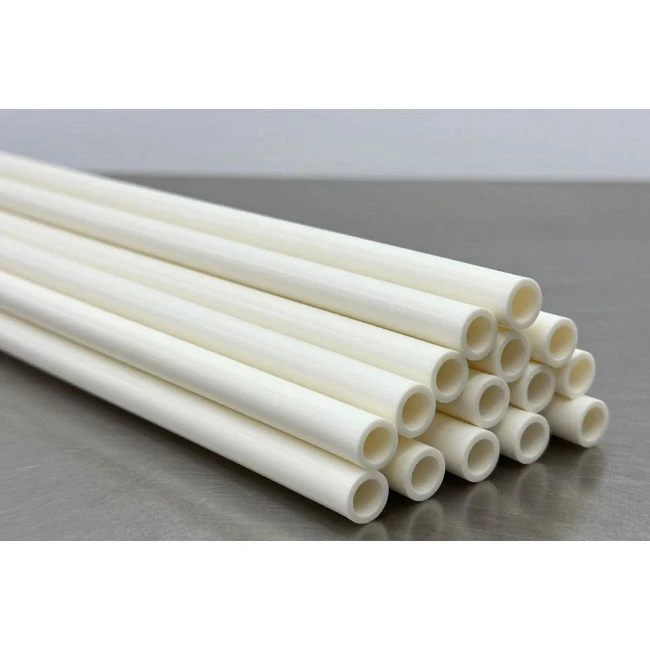
Technical ceramic sheath tubes engineered to protect thermocouples and RTDs in aggressive industrial environments. Built for thermal stability, gas-tightness, and corrosion resistance up to 1800°C.
-
![Gas-Tight Ceramic Sheath Tubes]() Gas-Tight Ceramic Sheath TubesGas-tight ceramic sheath tubes act as the frontline barrier protecting thermocouples, heating elements, and gas-sampling probes from corrosive process gases, mechanical impact, and oxidation at...read more
Gas-Tight Ceramic Sheath TubesGas-tight ceramic sheath tubes act as the frontline barrier protecting thermocouples, heating elements, and gas-sampling probes from corrosive process gases, mechanical impact, and oxidation at...read more -
![Wear-Resistant Ceramic Sheath Tubes]() Wear-Resistant Ceramic Sheath TubesIndustrial processes involving high-velocity abrasive particles and extreme temperatures cause rapid degradation of standard metal thermowells and low-purity ceramic tubes. These Wear-Resistant...read more
Wear-Resistant Ceramic Sheath TubesIndustrial processes involving high-velocity abrasive particles and extreme temperatures cause rapid degradation of standard metal thermowells and low-purity ceramic tubes. These Wear-Resistant...read more -
![High-Temperature Ceramic Sheath Tubes]() High-Temperature Ceramic Sheath TubesTechnical Compliance & Quality Assurance: Manufactured under ISO 9001:2015 quality management standards. 100% Helium leak-tested. Comprehensive Material Test Reports (MTR) provided with every...read more
High-Temperature Ceramic Sheath TubesTechnical Compliance & Quality Assurance: Manufactured under ISO 9001:2015 quality management standards. 100% Helium leak-tested. Comprehensive Material Test Reports (MTR) provided with every...read more -
![Thermocouple Ceramic Sheath Tubes]() Thermocouple Ceramic Sheath TubesAccurate temperature telemetry in aggressive industrial processing depends on the structural integrity of the primary sensor sheath. Our industrial ceramic tubes shield thermocouple assemblies...read more
Thermocouple Ceramic Sheath TubesAccurate temperature telemetry in aggressive industrial processing depends on the structural integrity of the primary sensor sheath. Our industrial ceramic tubes shield thermocouple assemblies...read more -
![Silicon Carbide Ceramic Sheath Tubes]() Silicon Carbide Ceramic Sheath TubesSelecting the correct SiC grade prevents premature thermal fatigue and chemical degradation when paired with noble or base-metal thermocouples. Review the material properties below to match your...read more
Silicon Carbide Ceramic Sheath TubesSelecting the correct SiC grade prevents premature thermal fatigue and chemical degradation when paired with noble or base-metal thermocouples. Review the material properties below to match your...read more -
![Alumina Ceramic Sheath Tubes]() Alumina Ceramic Sheath TubesAlumina ceramic sheath tubes provide mechanical housing and chemical shielding for thermocouples and temperature sensors operating in harsh thermal environments.read more
Alumina Ceramic Sheath TubesAlumina ceramic sheath tubes provide mechanical housing and chemical shielding for thermocouples and temperature sensors operating in harsh thermal environments.read more


Product Specification Matrix
Selecting the correct ceramic composition prevents premature sensor drift, chemical contamination, and structural failure.
|
Material Grade |
Alumina (Al2O3) Content |
Max. Operating Temp. |
Key Characteristics |
Typical Applications |
|
Recrystallized Alumina (R-Al2O3) |
>= 99.5% |
1800°C (3272°F) |
Ultra-high purity, zero open porosity, excellent high-temperature electrical insulation. |
Precious metal thermocouples (Type B, S, R), vacuum furnaces. |
|
Impervious Alumina (C799) |
>= 99.0% |
1700°C (3092°F) |
Gas-tight dense microstructure, balanced thermal shock resistance. |
Atmosphere furnaces, continuous heat treatment lines. |
|
Standard Alumina (C610 / C530) |
95% - 99% |
1500°C (2730°F) |
Cost-effective for moderate thermal loads, stable mechanical strength. |
Ceramic kilns, air duct monitoring. |
|
Silicon Carbide (SiC / SiSiC) |
Composite |
1600°C (2912°F) |
Extreme thermal shock resistance, high mechanical load capacity. |
Molten non-ferrous metals, waste incinerators. |
Dimensional Specifications & Manufacturing Tolerances
Standard outer diameters (OD) range from 6 mm to 50 mm, with single-piece lengths up to 2000 mm. Custom geometry is supported via technical drawing evaluation.
Standard OD Tolerances
+/- 0.5 mm or +/- 1% (whichever is greater); precision centerless ground options available for tight-tolerance compression fittings and sealing glands.
Wall Thickness
Controlled between 1.5 mm and 5 mm to balance thermal response speed and mechanical impact resistance.
End Configurations
One end closed (rounded hemispherical tip for uniform hoop stress distribution), both ends open, or with integrated mounting flanges/threads.
Straightness Deviation
<= 1.5 mm per 1000 mm length to eliminate binding risks during sensor insertion.
Engineering Guide: Material Selection Criteria
Proper specification requires balancing three operational constraints:
Thermal Shock Parameters
Rapid thermal cycles induce tensile surface stress. Applications with aggressive heating profiles require materials with high thermal conductivity and low thermal expansion (e.g., Silicon Carbide or fine-grained dense Alumina).
Chemical Compatibility
Reducing atmospheres or volatile basic fluxes react with silica binders in low-purity ceramics, causing structural embrittlement and platinum wire poisoning. Specify >= 99.5% R-Alumina for clean, reactive environments.
Atmosphere Permeability
Vacuum and controlled atmosphere furnaces require absolute gas-tightness to prevent process gas diffusion. Ensure tubes are certified gas-tight with zero open porosity.
Manufacturing consistency dictates field survivability. Our production workflow incorporates:
Forming Technology: Hydrostatic isostatic pressing (HIP) for large-diameter and long-span tubes to achieve uniform green density and eliminate internal laminations; precision extrusion for small-bore configurations.
Sintering Infrastructure: Continuous gas-fired and electric tunnel kilns operating up to 1850°C with computerized dwell-time profiling for complete matrix densification and stable crystal grain growth.
Quality Verification Protocols:
Dimensional Audit: 100% verification of outer diameter, concentric wall thickness, and straightness.
Gas Leak Screening: Helium mass spectrometry or pressure decay testing on closed-end impervious tubes.
Dielectric Testing: Verification of electrical insulation resistance at elevated test voltages.
Typical Application Scenarios
Metallurgical & Heat Treatment
Carburizing furnaces, vacuum brazing retorts, and annealing lines operating from 1300°C to 1750°C.
Non-Ferrous Foundry
Direct immersion protection for molten aluminum, zinc, and brass holding furnaces.
Petrochemical Processing
Sulfur recovery units, high-temperature fluid bed reactors, and flue gas emission monitoring lines.
Glass Manufacturing
Melting tank crown and checkerwork thermal profiling.
Supplier Evaluation Metrics
For engineering procurement teams conducting vendor audits:
Production Capability
15 automated isostatic presses, 6 high-temperature tunnel kilns; batch scaling from 50 prototype units to 10,000+ serial production runs.
Lead Times
7 to 10 business days for custom drawing review and tooling preparation; 3 to 4 weeks for standard production delivery.
Documentation Support
Full material data sheets, certificate of analysis (CoA), and custom export packaging designed to prevent transit breakage.
Frequently Asked Questions

Request an Engineering Evaluation & RFQ
To specify ceramic sheath tubes for your operating environment, provide our engineering team with the following parameters:
Operating temperature range and furnace atmosphere type (oxidizing, reducing, vacuum, or corrosive gas).
Required inner diameter (ID), outer diameter (OD), and total length.
Sensor assembly type housed within (e.g., Type K, Type S thermocouple).
Estimated annual volume or immediate prototype sample requirement.
As one of the most professional ceramic sheath tubes manufacturers and suppliers in China, we also support customized service. Please rest assured to wholesale high quality ceramic sheath tubes in stock here from our factory. Contact us for more details.
Alumina Ceramic Buttons, ceramic heat resistant spacer, ceramic structural fitting