

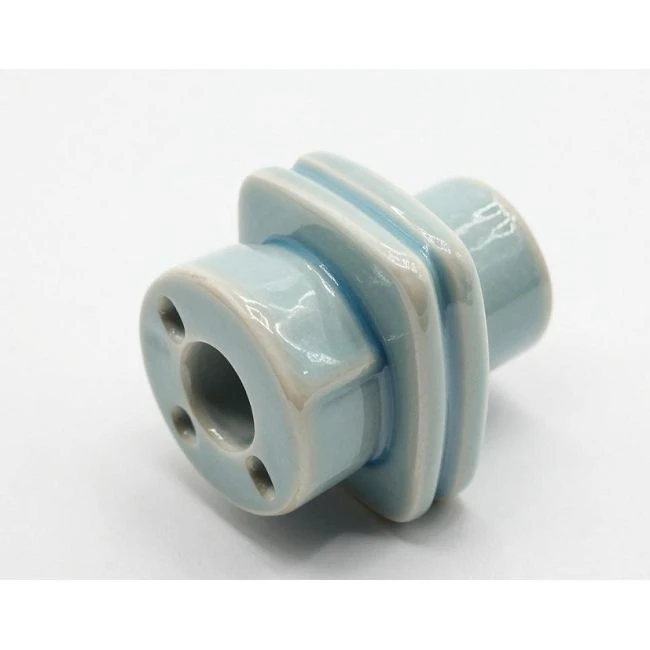
High-Temperature Ceramic Terminal Blocks: Engineering & Sourcing Guide
Product Overview & Core Specifications
Ceramic terminal blocks provide secure wire-to-wire connections in environments where standard thermoplastic housings (PA66, PC) fail due to extreme heat or fire hazards. Molded from steatite or high-alumina porcelain, these blocks maintain structural rigidity and insulation integrity up to 800°C.
Standard Technical Specifications
- Body Material: Steatite Ceramic (C221) or High-Alumina Ceramic (95% Al2O3), molded with standard dimensional tolerances of ±0.1 mm.
- Metal Insert Material: Nickel-plated brass / Copper alloy with zinc-plated steel or stainless steel screws.
- Max Continuous Operating Temperature: Up to 500°C (glaze-free) / 800°C (unglazed technical ceramic).
- Rated Voltage: 250V – 600V AC.
- Rated Current: 10A, 15A, 30A, 50A (dependent on cross-section and pole size).
- Dielectric Strength: > 10 kV/mm.
- Flammability Rating: UL94-V0 equivalent (Inorganic, non-combustible).
Selection Matrix & CAD Downloads
Select the appropriate series based on your thermal and electrical constraints. Download 3D CAD models (STEP/IGES) and 2D drawings directly to integrate into your assembly designs.
|
Series Code |
Poles |
Max Current |
Max Wire Size |
CAD & Engineering Files |
Primary Application |
|
CTB-01 |
1-Pole (Glazed) |
15A |
2.5 mm2 (14 AWG) |
[3D STEP] / [2D PDF] |
Lighting fixtures, small heating elements |
|
CTB-02 |
2-Pole, 3-Compartment |
30A |
4.0 mm2 (12 AWG) |
[3D STEP] / [2D PDF] |
Electric ovens, laboratory furnaces |
|
CTB-03 |
3-Pole, Multi-Hole |
50A |
10.0 mm2 (8 AWG) |
[3D STEP] / [2D PDF] |
Industrial heaters, heavy machinery power input |
Thermal Evaluation: If ambient operating temperature exceeds 150°C, rule out engineering plastics and select ceramic blocks.
Mechanical Load & Vibration: For high-vibration machinery, specify blocks featuring captive stainless steel screws and anti-rotation terminal inserts.
Clearance & Creepage: Verify voltage tier against working voltage to ensure adequate clearance distance across poles.
Manufacturing, Quality Control & Compliance
Reliable electrical performance relies on precise raw material mixing, controlled tunnel kiln firing profiles, and rigorous post-machining tolerance checks.
Material Sourcing & Pressing: High-purity steatite powder processed with strict moisture control to eliminate internal micro-voids during dry pressing.
Kiln Sintering: Sintered in automated tunnel kilns at temperatures exceeding 1300°C with precise thermal profiling, achieving full vitrification and a dense, non-porous structure (water absorption < 0.1%).
Metal Insert Assembly: Brass/copper inserts secured via mechanical interference fit or high-temp inorganic cement, preventing pull-out under rated torque.
Testing Protocol:
- High-potential (Hi-Pot) flash test at 2500V for 60 seconds.
- Torque testing on screws to verify thread integrity and prevent stripping.
- Thermal shock cycling (ambient to 400°C) to screen for structural cracking.
Certifications: UL Listed (UL 1059 standard), CE compliant, RoHS and REACH compliant.
Visual Inspection & Factory Proof
Ceramic Micro-Structure Analysis: High-magnification inspection ensures zero internal micro-voids, preventing catastrophic dielectric breakdown under high-voltage load.
Plating Thickness Verification: XRF testing guarantees nickel plating layer thickness on brass inserts meets ASTM standards for oxidation and corrosion resistance.
Frequently Asked Questions
Q: Can ceramic terminal blocks be used in direct contact with moisture or liquids?
A: The ceramic body itself is non-porous (water absorption < 0.1%), but the terminal block is an open assembly. If exposed to condensation or liquid spray, the complete enclosure (such as a junction box) must provide an appropriate IP rating.
Q: What is the maximum tightening torque for the terminal screws?
A: For standard 30A blocks with M3.5 screws, recommended torque is 0.8 Nm to 1.2 Nm. Exceeding this limit may strip the screw thread or crack the ceramic shoulder.
Q: Do you supply custom configurations (e.g., special hole spacing or mounting brackets)?
A: Yes. Tooling modifications for custom block dimensions, special pole counts, or integrated mounting feet require a minimum order quantity (MOQ) and a 3-week sample lead time based on technical drawings (STEP/IGES format).
Q: What are the standard packaging methods for bulk shipment?
A: Blocks are packed in partitioned anti-vibration EPE foam trays inside double-wall corrugated cartons to minimize transit breakage. Palletized export packaging is standard for sea freight.
Request Engineering Samples & Quotation
To evaluate samples for your specific application, prepare the following parameters when contacting our engineering team:
- Working voltage and operating current requirements.
- Peak operating temperature and thermal cycle profile.
- Target wire gauge (AWG or mm2) and stripping length.
- Annual consumption forecast for volume pricing.
[Request Technical Sample & RFQ] (Direct link to inquiry submission form)
Hot Tags: ceramic terminal blocks, China ceramic terminal blocks manufacturers, suppliers, factory


