

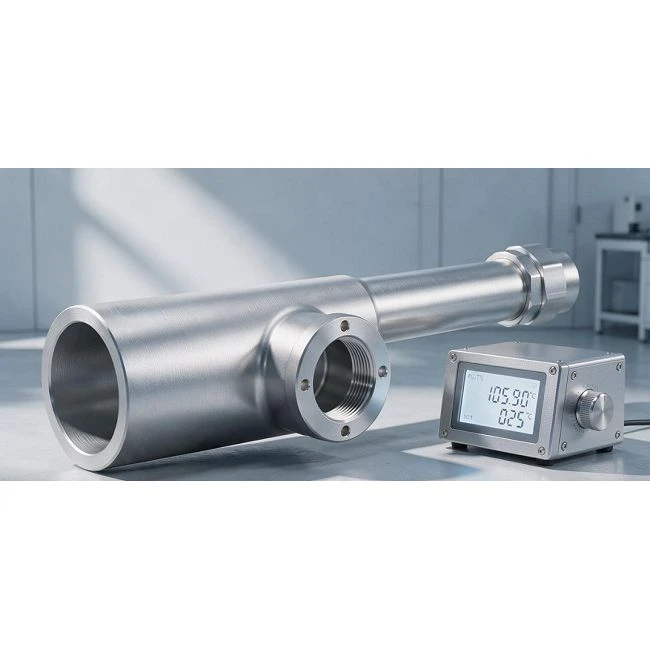
Custom Thermocouple Protection Tubes & Thermowells
Precision-machined protection tubes engineered to your exact thermal, mechanical, and chemical specifications.
Industrial temperature sensors demand robust physical defense in aggressive media. Our custom thermocouple protection tubes isolate sensing elements from direct chemical attack, mechanical abrasion, and high-velocity fluid forces without sacrificing thermal response time. Built from certified high-temperature alloys and advanced technical ceramics, every tube is manufactured strictly to your engineering drawings and process parameters.
Technical Specifications & Customization Options
|
Parameter |
Standard / Custom Range |
|
Material Grades |
Inconel 600/625, Hastelloy C276, Monel 400, Stainless Steel (310S, 316Ti, 446), Silicon Nitride (Si3N4), Sialon, Alumina (Al2O3 99%) |
|
Outer Diameter (OD) |
6 mm to 114 mm (custom diameters available via deep-hole drilling or slip casting/sintering) |
|
Wall Thickness |
Min. 1.5 mm up to 12.5 mm (tolerance control down to +/- 0.05 mm) |
|
Insertion Length (U) |
Up to 3000 mm (single-piece construction; segmented options available) |
|
Process Connections |
NPT/BSP Threads, ANSI/DIN Flanges, Sanitary Tri-Clamp, Weld-in stub |
|
Surface Finish |
Ra <= 0.4 um (internal/external polishing, passivation, or non-wetting ceramic glaze) |
Manufacturing & Quality Control
Solid-Bar Stock Machining: Produced from forged bar stock via CNC deep-hole drilling to eliminate internal seam defects present in welded tubes.
Weld Integrity: Full-penetration TIG/plasma welding utilized for flange-to-tube assemblies, verified by 100% dye penetrant testing (PT).
Material Traceability: Positive Material Identification (PMI) conducted on all incoming high-alloy stocks (Inconel, Hastelloy) with Mill Test Reports (MTRs) provided prior to shipment.
Pressure Testing: Hydrostatic pressure testing executed up to 1.5 times the design operating pressure upon request.
Typical Industrial Applications & Material Selection Guide
To streamline your engineering design process, match your operating conditions with our proven material deployment matrix:
|
Operating Environment |
Primary Challenge |
Recommended Material |
Manufacturing Focus |
|
High-Pressure Superheater Steam |
Severe fluid-induced wake frequency & high mechanical stress |
Inconel 625 / 310S |
Solid-bar gun drilling to eliminate weld seam vulnerability |
|
Sulfur Recovery & Petrochemical Cracking |
High-temperature sulfidation & aggressive chemical attack |
Hastelloy C276 / Monel 400 |
Full PMI material traceability & XRF verification |
|
Aluminum & Zinc Molten Metal Casting |
Non-ferrous metal erosion & chemical wetting |
Silicon Nitride (Si3N4) / Sialon |
Specialized high-density sintering & non-wetting glaze |
|
Rotary Kilns & Waste Incineration |
Alkaline corrosion & extreme abrasive particulate wear |
Alumina (Al2O3 99%) / Silicon Carbide |
Precision grinding for extreme dimensional straightness |
Request a Custom Quote & Technical Review
To initiate engineering review, supply your design parameters or upload your technical drawing (PDF/CAD):
Operating Parameters: Temperature and pressure extremes.
Media Characteristics: Corrosive compounds or abrasive particulate concentration.
Material Requirements: Specific alloy grade or industrial standard (ASTM, DIN, JIS).
Dimensional Limits: OD, Wall Thickness, Insertion Length, and Connection type.
Frequently Asked Questions
Q: What is the lead time for custom alloy protection tubes?
A: Standard prototypes or small-batch orders (10 to 50 pieces) in common alloys like 310S or Inconel 600 typically require 2 to 3 weeks. Rare alloys (e.g., Hastelloy, Titanium) or technical ceramics requiring specialized sintering depend on raw material stock status, generally averaging 4 to 5 weeks.
Q: How do you prevent concentricity drift during deep-hole drilling?
A: We utilize heavy-duty CNC gun-drilling centers equipped with high-pressure coolant through-spindle systems. This maintains strict wall thickness uniformity and concentricity along lengths up to 3000 mm, preventing localized thin spots that fail prematurely under high pressure.
Q: Can you supply Material Test Reports (MTRs) for high-nickel alloys?
A: Yes. Every shipment includes EN 10204 3.1 material test certificates. We also perform in-house Positive Material Identification (PMI) using XRF analyzers to verify chemical composition before machining begins.
Q: When should I choose a ceramic protection tube over a metal alloy?
A: Choose technical ceramics (such as Silicon Nitride, Sialon, or Recrystallized Alumina) when operating temperatures exceed metal limits (above 1150°C up to 1600°C+) or when processing environments cause rapid oxidation or chemical attack on metallic grain boundaries. Note that traditional ceramics require proper preheating to mitigate thermal shock.
Q: Are welded thermowells or solid-drilled protection tubes better for high-velocity flows?
A: Solid-drilled protection tubes are strictly recommended for high-velocity fluid streams (such as high-pressure steam lines). Solid bars eliminate the root weld vulnerability associated with fabricated tubes, preventing catastrophic wake-frequency vibration failures.
Q: What connection standards are supported for flanges and threads?
A: We machine process connections to match international standards, including ANSI B16.5 flanges, DIN EN 1092-1 flanges, JIS B2220 flanges, and NPT/BSP tapered or parallel pipe threads. Custom tapered shank profiles can also be machined to match specific socket-weld
Hot Tags: custom thermocouple protection tubes, China custom thermocouple protection tubes manufacturers, suppliers, factory


