

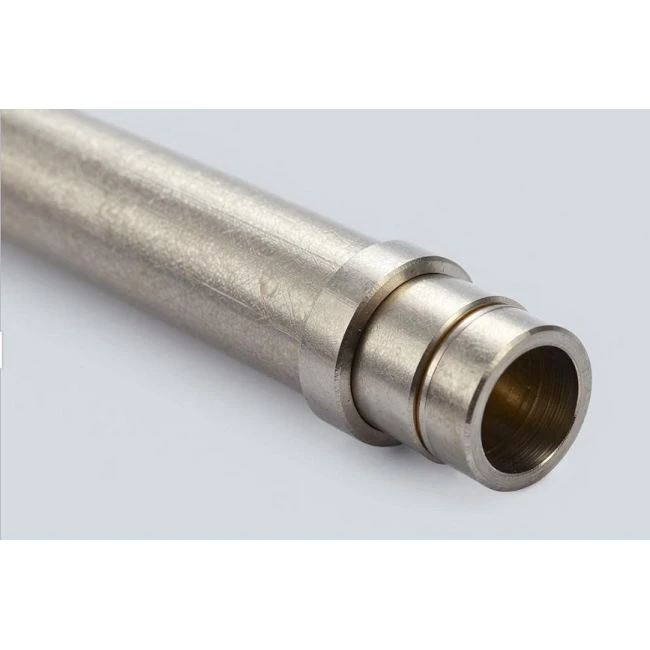
Gas-Tight Thermocouple Protection Tubes
Product Overview & Technical Definition
Gas-Tight Thermocouple Protection Tubes provide primary physical and chemical containment for industrial temperature sensors operating in severe thermal and corrosive environments. Engineered with dense, zero-porosity microstructures impervious to helium gas migration, these tubes prevent reactive furnace atmospheres, molten metals, and combustion byproducts from degrading the thermocouple element or causing premature sensor failure.
Technical Specifications & Material Selection
|
Material Grade |
Max. Operating Temp |
Key Properties & Limitations |
Primary Applications |
|
Recrystallized Alumina (Al2O3 >= 99.5%) |
1700°C to 1800°C |
Exceptional chemical inertness, high dielectric strength; moderate thermal shock resistance. |
Vacuum furnaces, oxidizing/reducing atmospheres, semiconductor crystal growth. |
|
Silicon Carbide (SiC / RBSSiC) |
1450°C to 1650°C |
High thermal conductivity, superior mechanical strength, excellent abrasion resistance. |
Waste-to-energy incinerators, large industrial boilers, high-wear zones. |
|
Inconel 600 / HR Alloys |
1150°C |
Rapid thermal response, high mechanical impact resistance, fully weldable. |
Low-to-medium temperature salt baths, fluidized beds, chemical reactors. |
Sizing & Dimensional Tolerances
Custom manufacturing accommodates specific drop lengths, inner/outer diameters, and mounting configurations to match existing assemblies:
Standard Outer Diameters (OD): 8 mm to 50 mm
Maximum Continuous Length: Up to 2000 mm (engineered to restrict material sag limits at extreme high temperatures)
Concentricity Tolerance: <= +/- 0.15 mm to ensure uniform wall thickness and eliminate localized hot spots.
End Configurations: Open-one-end (closed bottom), closed-both-ends, or integrated with precision ceramic-to-metal flanges and mounting bushings.
Application Suitability Guide
Matching material thresholds to specific process chemistry prevents catastrophic failure:
Carburizing & Nitriding Furnaces: Require ultra-pure Alumina to withstand carbon and nitrogen diffusion without degrading internal insulation resistance.
Vacuum Heat Treating: Demands high-purity ceramic tubes that eliminate outgassing and protect high-vacuum chambers from contamination.
Corrosive Gas Scrubbers: Alloy or specialized ceramic configurations resistant to sulfur dioxide and halogen gas compounds.
Manufacturing Process & Quality Control
Forming: Isostatic pressing (CIP) utilized for high-density ceramic tubes, ensuring uniform grain distribution and eliminating internal micro-voids.
Sintering: High-temperature controlled-atmosphere kilns producing fully densified crystalline structures.
Verification & Testing:
- Helium mass spectrometer leak testing verifying absolute gas-tight integrity.
- Dimensional verification via coordinate measuring machine (CMM).
- Dye penetrant inspection for alloy tubes; ultrasonic flaw detection for heavy-wall structural integrity.
Request for Quote (RFQ) Checklist
To accelerate engineering review and quotation accuracy, include the following parameters in your inquiry:
Process Temperature: Maximum operating temperature and thermal cycling frequency.
Atmosphere Chemistry: Presence of reducing gases (H2, CO), vacuum levels, or corrosive chemical agents.
Physical Dimensions: Outer Diameter (OD), Inner Diameter (ID), and total immersion length.
Mounting Architecture: Threaded fittings, ceramic collars, or compression flanges required.
Volume Requirements: Prototype testing batch quantities vs. annual production forecasts.
Frequently Asked Questions
Q: How do you verify that the ceramic protection tubes are truly gas-tight?
A: Every production batch undergoes helium mass spectrometer leak testing under vacuum conditions. Tubes must exhibit a verified leak rate below 1 x 10^-8 Pa*m^3/s to pass internal quality release protocols.
Q: What causes high-purity alumina tubes to crack during initial startup?
A: Thermal shock is the primary failure mechanism. Alumina possesses high compressive strength but lower tensile strength under rapid thermal gradients. Preheating the furnace slowly (following a recommended ramp rate of <= 150°C/hour below 800°C) mitigates thermal expansion stress.
Q: Can protection tubes be manufactured with custom mounting flanges?
A: Yes. Integration with stainless steel or high-nickel alloy mounting flanges via brazing, glass-sealing, or mechanical compression seals is standard for custom OEM orders.
Q: What is the maximum continuous service temperature for 99.5% Alumina tubes?
A: Continuous operating limits reach 1700°C in clean oxidizing or inert atmospheres. Exceeding 1800°C causes structural softening and potential chemical reaction with silica-based impurities if present.
Q: How does tube wall thickness impact thermocouple response time?
A: Thinner walls reduce thermal lag, improving sensor response speed. However, wall thickness must balance mechanical durability against physical stress from high fluid velocities or mechanical loading inside the vessel.
Q: What documentation is supplied with commercial shipments?
A: Material Test Reports (MTR) detailing chemical purity assays, dimensional inspection reports, and helium leak test certificates are provided upon request prior to dispatch.
Hot Tags: gas-tight thermocouple protection tubes, China gas-tight thermocouple protection tubes manufacturers, suppliers, factory, alumina ceramic spacer, ceramic abrasion block, Ceramic Disc Heating Element, ceramic electronic insulator part, ceramic gasket ring, ceramic tube connector sleeve


