

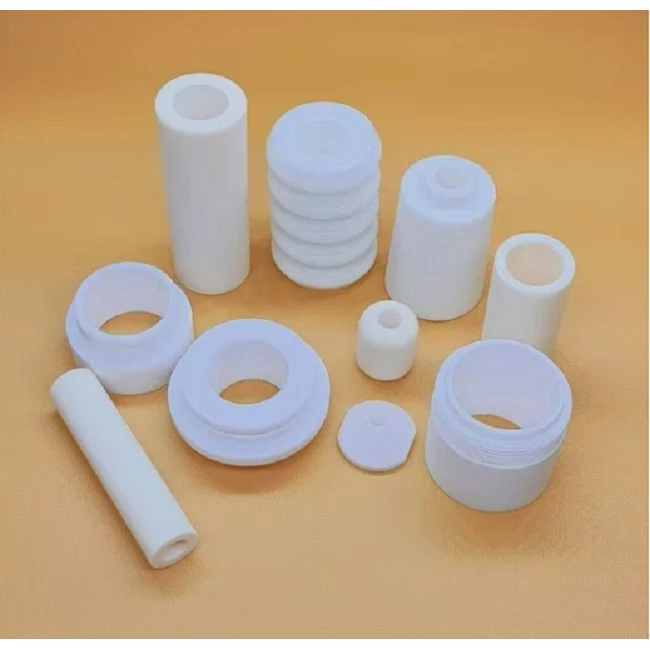
Ceramic-to-Metal Brazing Assemblies & Metallization Techniques
Overview & Core Engineering Function
Ceramic-to-metal assemblies combine the high dielectric and thermal stability of alumina ceramics with the ductility and connection versatility of refractory metals. These components are engineered for high-vacuum, high-voltage, and extreme thermal-cycling environments where traditional elastomeric seals or polymer adhesives fail.
Key Performance Characteristics
- Hermetic Sealing: Capable of achieving helium leak rates of < 10^-9 Pa*m3/s under UHV (Ultra-High Vacuum) conditions.
- Thermal Shock Resistance: Withstands abrupt temperature transitions from cryogenic levels up to 600 °C without joint delamination.
- Mechanical Integrity: Tensile strength of brazed joints often exceeds the shear strength of the ceramic base material itself.
Metallization & Brazing Process Workflow
Creating a reliable, hermetic bond between a non-metallic ceramic and a metal conductor requires a strictly controlled multi-stage metallurgy process.
Alumina Insulator Substrate
Molybdenum-Manganese (Mo-Mn) Coating
Hydrogen Furnace Sintering (1300 °C - 1500 °C)
Electroplated Nickel Layer (2 - 5 µm)
Active/Ag-Cu Brazing with Metal Hardware (Kovar / SS304 / Copper)
Helium Mass Spectrometer Leak Testing
Surface Preparation & Metallization: We utilize the conventional Molybdenum-Manganese (Mo-Mn) powder method, screen-printed or painted onto targeted ceramic surfaces, then fired in a wet hydrogen atmosphere to form a tight chemical-metallurgical bond.
Electroplating: A dense nickel layer is electroplated over the Mo-Mn base layer to prevent oxidation and optimize wetting during the subsequent brazing operation.
Brazing Alloys: Utilizing high-purity silver-copper (Ag-Cu) eutectic filler metals (e.g., Cusil) under vacuum or protective inert gas atmospheres to join components with matched thermal expansion coefficients (CTE).
Common Material Combinations & CTE Matching
A primary failure mode in ceramic-to-metal brazing is thermal stress induced by mismatched Coefficient of Thermal Expansion (CTE) values between the ceramic and the metal hardware.
|
Metal Alloy |
CTE (10^-6/K at 20-500 °C) |
95% / 99% Alumina CTE |
Primary Engineering Application |
|
Kovar (Fe-Ni-Co) |
5.1 - 5.3 |
7.5 - 8.2 |
X-ray tubes, vacuum power interrupters, electronic vacuum tubes |
|
OFHC Copper |
16.5 |
7.5 - 8.2 |
High-current power feedthroughs (utilizing tapered stress-relief joints) |
|
304 / 316L Stainless Steel |
16.0 - 17.5 |
7.5 - 8.2 |
Flanged vacuum breaks, instrumentation viewports |
|
Titanium (Grade 2/5) |
8.6 - 9.0 |
7.5 - 8.2 |
Medical implant housings, aerospace sensor bodies |
Quality Assurance & Hermeticity Testing
Because these assemblies frequently serve as critical barriers in semiconductor chambers and aerospace systems, 100% verification is enforced:
Helium Leak Detection: Every brazed assembly is tested using high-sensitivity mass spectrometer leak detectors under vacuum.
Destructive Shear Testing: Periodic sample pulling to verify that joint breaking loads meet minimum structural thresholds.
X-Ray / Ultrasonic Imaging: Non-destructive evaluation of internal brazing fillets to detect voids, un-wetted zones, or trapped micro-flux pockets.
Frequently Asked Questions
Q: What is the maximum bake-out temperature for your ceramic-metal assemblies?
A: Standard assemblies utilizing standard Ag-Cu filler metals can endure repeated vacuum bake-outs up to 450 °C. For higher thermal requirements, high-temperature noble metal brazing alloys (such as Gold-Copper or Gold-Nickel) can be specified up to 700 °C.
Q: How do you mitigate thermal expansion mismatch between stainless steel and alumina?
A: We design transition stress-relief geometries-such as thin-walled feather-edge transition skirts made of Kovar or flexible copper sleeves-which elastically absorb the thermal strain differentials during high-temperature brazing and operational thermal cycling.
Q: Can you process customer-supplied metal components for brazing?
A: Yes. We regularly accept customer-specified metal flanges, pins, and housing components (provided material certs and cleanliness protocols are met) to braze directly onto our custom-molded alumina insulators.
Hot Tags: alumina ceramic insulators, China alumina ceramic insulators manufacturers, suppliers, factory, ceramic abrasion block, ceramic assembly spacer ring, ceramic fitting component, ceramic heat resistant spacer, ceramic terminal insulator, ceramic wear spacer


