

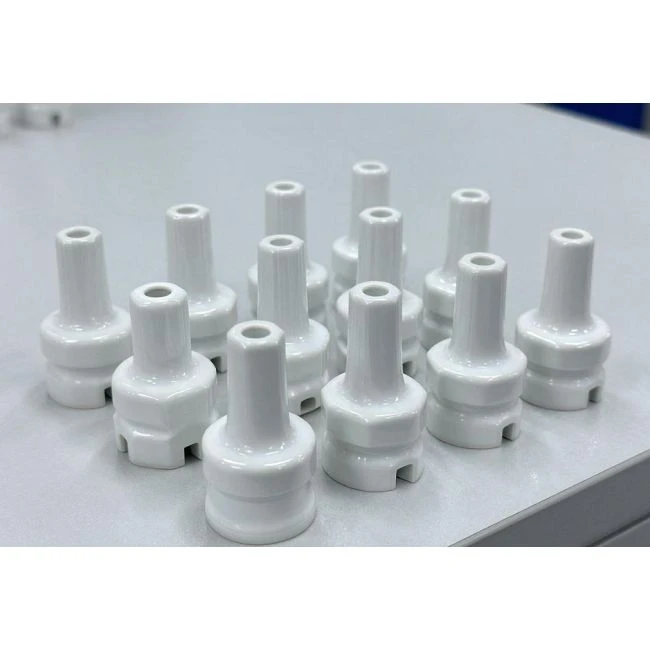
Custom Ceramic Terminal Blocks | OEM/ODM High-Temp Solutions
Engineered for extreme thermal environments (> 600°C), our custom ceramic terminal blocks are manufactured via dry-pressing or isostatic pressing using high-purity steatite (C221) and alumina (Al2O3) ceramics. We build to your exact CAD drawings, integrating custom brass, stainless steel, or nickel-plated copper hardware.
Quick Product Selection Guide
|
Model / Type |
Material Base |
Max Operating Temp |
Dielectric Strength |
Primary Use Case |
|
ST-95 (Standard Steatite) |
Steatite C221 |
800°C |
> 6 kV/mm |
General industrial furnaces, heating elements |
|
AL-99 (High-Purity Alumina) |
99% Al2O3 |
1400°C |
> 12 kV/mm |
High-voltage, extreme thermal shock environments |
|
Custom Insert Config |
Steatite / Alumina |
Dependent on insert |
Dependent on spacing |
Terminal blocks with captive screws, studs, or eyelets |
Technical Specifications & Material Data
Ceramic Body Compositions:
Steatite (Grade C221): MgO·SiO2 matrix. High mechanical strength, excellent high-frequency electrical insulation, cost-effective for temperatures up to 1000°C. Linear thermal expansion coefficient: 7.5 x 10^-6/K (20°C - 600°C).
Alumina (95% to 99.5%): Superior hardness, zero porosity, high thermal conductivity, and extreme resistance to chemical corrosion at temperatures up to 1500°C.
Dimensional Tolerances: Conforms to DIN 40680 Medium / Fine standards (typically ±1% or ±0.1 mm, whichever is greater). Grinding services available for critical mating faces.
Metal Insert Hardware: Brass (standard), nickel-plated brass, 304/316 stainless steel, or steel screws (M3 to M8). Inserts are fixed via ultrasonic embedding, high-temperature cement, or mechanical locking.
Surface Finish: Unglazed or glazed (silicon-based high-temp glaze) to prevent moisture absorption in humid operating conditions.
Manufacturing & Quality Control Process
Tooling & Mold Design: In-house mold fabrication (CNC machining and EDM) for fast prototyping of custom geometries. Shrinkage compensation calculated specifically for your batch chemistry.
Forming Techniques:
- Dry Pressing: Ideal for high-volume, uniform block geometries.
- Isostatic Pressing: Recommended for thick-walled, complex shapes requiring uniform density and zero internal micro-voids.
- Sintering (Firing): Controlled atmosphere tunnel kilns operating up to 1650°C. Temperature profiles are monitored to eliminate thermal gradient cracking and control crystalline phase growth.
- Post-Processing & Assembly: Precision grinding of mounting faces, automated thread-pull testing for metal inserts, and 100% visual inspection for surface fissures.
Testing Protocols:
- Dielectric Breakdown Test: Performed according to ASTM D149.
- Thermal Shock Testing: Quenched from 500°C to room temperature water baths to verify structural integrity.
- Torque Testing: Verifying insert pull-out and thread stripping resistance under specified assembly torque.
Application & Industry Fit
Industrial Electric Furnaces: Termination blocks for resistance wire heating elements operating at continuous high loads. (Proven in continuous-duty industrial heat-treating furnaces operating at 900°C for over 3 years)
Commercial Food Equipment: Commercial ovens, conveyor pizza ovens, and industrial dryers where organic plastics degrade. (Proven in commercial convection ovens enduring repeated 350°C daily thermal cycles)
HVAC Systems: Igniter blocks and sensor mounting terminals exposed to direct gas flame and thermal cycling.
Laboratory & Analytical Instruments: High-temperature tube furnaces and vacuum system feedthrough insulators.
Supplier Evaluation & Compliance
Material Traceability: Lot-controlled raw ceramic powder with accompanying Material Test Reports (MTRs) per shipment.
Regulatory Compliance: Fully compliant with RoHS, REACH, and CE electrical safety directives.
Export Packaging: Vacuum-sealed inner blister packs layered with high-density EPE foam inside reinforced double-wall export cartons to eliminate transit chipping.
Frequently Asked Questions
Q: What is the typical lead time for custom tooling and initial samples?
A: Tooling fabrication and sample production take 3 to 4 weeks from 2D/3D CAD drawing approval (STEP or IGES format). Mass production lead time is typically 3 to 4 weeks depending on batch volume.
Q: Can you mold metal inserts directly into the ceramic during firing, or are they assembled post-sintering?
A: We utilize both methods. Post-sintering mechanical insertion with high-temperature epoxy or expansion fit is standard for most terminal blocks to prevent differential thermal expansion mismatch between metal and ceramic during kiln firing. Direct co-firing is available for specific alumina designs.
Q: What is the Minimum Order Quantity (MOQ) for custom geometries?
A: MOQ is determined by pressing batch size, typically starting at 1,000 to 3,000 pieces per production run. Lower quantities can be accommodated for initial prototyping runs with amortized tooling fees.
Q: How do you prevent thread stripping on terminal block screws?
A: We specify high-strength brass or stainless steel threaded inserts with deep knurling profiles, embedded to precise depth tolerances. Every production lot undergoes torque testing to verify holding force against specified tightening limits.
Request a Custom Quote
To generate a precise quotation, please provide the following details via email:
2D Drawing / 3D CAD Model: Showing critical dimensions, hole spacing, and tolerance limits.
Operating Conditions: Continuous operating temperature, voltage, and expected current load.
Hardware Requirements: Insert thread size (e.g., M4, M5) and material preference.
Annual Volume: Estimated usage per release.
Hot Tags: custom ceramic terminal blocks, China custom ceramic terminal blocks manufacturers, suppliers, factory


