

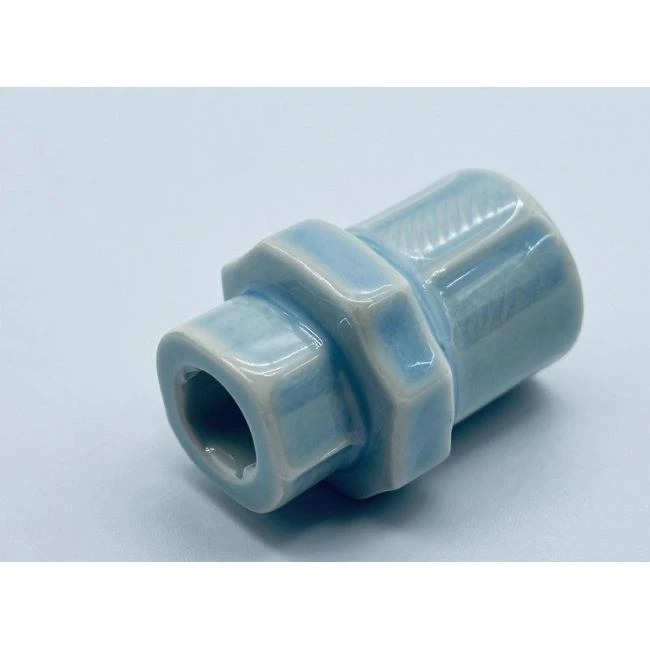
Alumina Ceramic Terminal Blocks: Technical Sourcing & Engineering Guide
Product Identification & Overview
Alumina ceramic terminal blocks provide stable electrical insulation and mechanical wire retention in thermal and electrical environments exceeding the limits of standard engineering plastics (such as PA66 or Bakelite) and traditional electrical porcelain. Molded from aluminum oxide (Al2O3) and sintered at high temperatures, these components maintain structural integrity and dielectric performance under continuous operating temperatures up to 1500°C.
Available Configurations: 1-pole, 2-pole, 3-pole, and custom multi-pole modular layouts.
Current Ratings: 15A to 100A (governed by terminal cross-section and metal insert gauge).
Voltage Rating: Up to 600V-1000V operational limits.
Compliance & Traceability: RoHS compliant; raw material lots certified to ISO 9001 quality management standards.
Technical Specifications & Material Data
Match the physical and electrical properties below against your system drawing requirements:
|
Property |
Standard Value (95% Alumina) |
Test Method / Standard |
|
Max Continuous Operating Temp |
1400°C (2552°F) |
ASTM C408 |
|
Dielectric Strength |
>15 kV/mm |
ASTM D149 |
|
Volume Resistivity (20°C) |
>10^14 Ohm*cm |
ASTM D257 |
|
Flexural Strength |
300 MPa |
ASTM F417 |
|
Thermal Expansion (20-500°C) |
7.5 x 10^-6 / K |
ASTM C372 |
|
Metal Insert Material |
Nickel-plated brass / Stainless Steel 304 |
DIN EN 10088 |
Selection Guide: Choosing the Right Block
Selecting the correct terminal block requires balancing thermal shock limitations, mechanical loads, and electrical clearance requirements.
Standard Grade (95%-96% Al2O3): Specified for general industrial heating equipment, commercial ovens, and resistance wire terminations up to 1200°C. Provides an optimal balance of mechanical strength and thermal shock resistance.
High-Purity Grade (99% Al2O3): Recommended for semiconductor processing chambers, high-vacuum systems, and analytical instruments where alkali metal contaminants or outgassing must be avoided at elevated temperatures.
Terminal Design Selection:
- Screw-down clamps: Suitable for solid or stranded copper/nickel wire up to 10 AWG in static installations.
- Stud-type connectors: Specified for heavy-duty ring terminals in high-amperage power distribution lines.
Typical Industrial Applications
Alumina terminal blocks are engineered into OEM systems subject to continuous thermal and electrical stress:
Industrial Heat Treatment: Electric box furnaces, tube furnaces, and continuous annealing lines.
Thermal Processing: Ceramic kilns, glass tempering arches, and powder metallurgy sintering furnaces.
Heating Elements: Cartridge heater power distribution boxes and immersion heater assemblies.
Exhaust & Emissions: High-temperature gas analyzer probe connections and continuous emission monitoring systems (CEMS).
Manufacturing, Quality Control & Traceability
Reliable performance in high-voltage circuits depends on tightly controlled material density and defect-free sintering. Production methods include:
Dry Pressing & Isostatic Pressing: Applied to achieve uniform green density, preventing micro-voids and warping during firing.
High-Temperature Tunnel Kilns: Sintered under controlled atmospheric conditions to ensure complete densification and zero residual organic binders.
Quality Inspection Protocols:
- Dye Penetrant Testing: Performed on sample lots to screen for surface micro-cracks.
- High-Voltage Flashover Testing: 100% dielectric withstand testing prior to final packaging.
- Dimensional CMM Check: Verifies hole spacing, terminal seat depth, and mounting pitch tolerances (+/-0.1 mm).
Frequently Asked Questions
Q: How do alumina terminal blocks handle rapid temperature changes (thermal shock)?
A: Alumina exhibits high compressive strength but moderate thermal shock resistance compared to metals. To prevent cracking, system designs should limit ramp rates to below 150°C/hour in extreme environments, or select 99% purity grades for higher thermal conductivity.
Q: Can these blocks be used in a vacuum environment?
A: Yes. 95% and 99% alumina materials are vacuum-compatible, outgassing-free ceramics. For high-vacuum applications (<10^-5 Torr), specify unglazed blocks cleaned with ultrasonic solvent degreasing.
Q: What is the maximum tightening torque for the metal screws?
A: For standard M4 screws housed in ceramic bodies, do not exceed 1.2 N*m of torque to prevent localized point-stress cracking on the ceramic web.
Q: Do you provide custom dimensions or OEM metal insert configurations?
A: Yes. Production capabilities support custom ceramic bodies from 3D CAD models, along with customized stainless steel or nickel-plated copper terminal inserts per application drawings.
Request a Quote or Engineering Samples
To evaluate samples or request production pricing for custom configurations, provide the following parameters in your inquiry:
- Operating voltage and maximum current load.
- Maximum ambient temperature at the terminal mounting point.
- Wire gauge (10 AWG / mm²) and termination style (stripped wire vs. ring terminal).
- Estimated annual volume or prototype quantity required.
[Submit RFQ / Request Technical Drawing Review]
Hot Tags: alumina ceramic terminal blocks, China alumina ceramic terminal blocks manufacturers, suppliers, factory, Alumina Ceramic Rings, ceramic heat resistant spacer, ceramic protection sleeve accessory, ceramic sealing ring, ceramic support insulator, ceramic wear resistant accessory


