

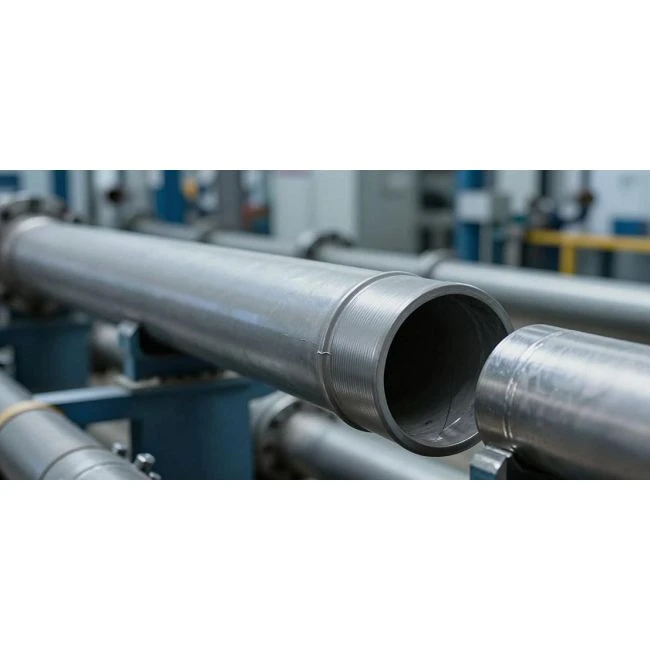
High-Alumina Wear-Resistant Ceramic Sheath Tubes for Extreme Thermal & Abrasive Environments
Industrial processes involving high-velocity abrasive particles and extreme temperatures cause rapid degradation of standard metal thermowells and low-purity ceramic tubes. These Wear-Resistant Ceramic Sheath Tubes (engineered using 95% to 99.3% Alumina) protect internal sensors (such as thermocouples and RTDs) and extend structural lifespan in harsh operating conditions.
Material Composition: Al2O3 (95% - 99.3%), ZTA (Zirconia Toughened Alumina)
Maximum Service Temperature: Up to 1700°C (dependent on purity and atmosphere)
Standard Outer Diameters (OD): 8 mm to 50 mm
Standard Lengths: Up to 1800 mm (custom lengths available upon request)
Technical Specifications & Material Grades
|
Grade |
Al2O3 Content |
Density (g/cm3) |
Max Temp (°C) |
Hardness (Mohs) |
Primary Application |
|
AL-950 |
95.0% |
>= 3.65 |
1350 |
9 |
General abrasive slurries, moderate thermal shock |
|
AL-990 |
99.0% |
>= 3.85 |
1600 |
9+ |
High-temperature flue gas, chemical vapor resistance |
|
AL-993 |
99.3% |
>= 3.89 |
1700 |
9+ |
High-purity electronic furnaces, reducing atmospheres |
|
ZTA |
Alumina + ZrO2 |
>= 4.10 |
1400 |
9.5 |
High mechanical impact, severe thermal cycling |
Key Selection Criteria for Engineers
Selecting the correct ceramic sheath tube prevents premature sensor failure. Evaluate the following operating conditions during selection:
Thermal Shock Resistance: If the tube experiences rapid temperature fluctuations (e.g., insertion into an active hot furnace), select ZTA or lower-purity Alumina (AL-950) over high-purity variants, as higher crystal purity reduces tolerance to thermal shock.
Abrasion vs. Temperature Trade-off: High-velocity fly ash in coal-fired boilers requires high hardness (AL-990 or higher) to resist particle impingement wear.
Wall Thickness & Concentricity: Standard wall thicknesses range from 1.5 mm to 5 mm. Thicker walls increase mechanical strength but lower thermal response times for enclosed temperature sensors.
Manufacturing Process & Quality Control
Our production process ensures structural integrity and dimensional consistency across high-volume batches:
Forming Technology: Isostatic pressing and precision extrusion for uniform density distribution and elimination of internal micro-voids.
Sintering: Controlled-atmosphere high-temperature tunnel kilns operating above 1600°C to achieve optimal grain growth and fully closed porosity.
Dimensional Inspection: 100% visual inspection combined with laser outer diameter and straightness checks (tolerance controlled within +/- 0.15 mm per meter).
Gas-Tightness Testing: Helium leak detection performed on sealed-end tubes to verify zero porosity before shipment.
Traceability & Compliance: Full batch traceability supported by EN 10204 3.1 Material Test Reports (MTR) and compliance verification against international standards (such as ASTM C1161 for flexural strength and ISO 14705 for ceramic properties) provided upon request.
Typical Industrial Applications
Power Generation: Boiler flue gas temperature monitoring, selective catalytic reduction (SCR) systems.
Metallurgy & Steelmaking: Continuous casting tundish temperature profiling, heat treatment furnace protection tubes.
Cement & Minerals: Rotary kiln calcining zone exhaust monitoring and clinker cooler temperature measurement.
Chemical Processing: Fluidized bed reactor thermowells exposed to corrosive catalysts and solid particle erosion.
Supplier Evaluation: Why Source From Us?
Raw Material Control: We source sub-micron calcined alumina powder with verified batch traceability certificates.
Custom Tooling Capability: In-house mold fabrication enables rapid prototyping of non-standard inner/outer diameters, threaded ends, and flanged configurations.
Sample Policy & Minimum Order Quantities (MOQ):
- Prototypes & Samples: We provide engineering validation samples and standard testing documentation to support qualification testing for new OEM and MRO deployments.
- Flexible MOQ: Standard catalog sizes are available for low-volume trial orders, with scalable production tiers for high-volume contract schedules.
- Export Packaging Standards: Tubes are packed individually in shock-absorbing EPE foam, separated by corrugated partitions, and crated in fumigation-free plywood boxes to eliminate transit breakage.
Frequently Asked Questions
Q: What is the maximum allowable thermal shock gradient for 99% Alumina tubes?
A: AL-990 tubes can typically tolerate sudden temperature changes up to 200°C to 250°C without cracking. Preheating the sheath tube to approximately 300°C before insertion into high-temperature zones is strongly recommended for lengths exceeding 1000 mm.
Q: Can these sheath tubes be manufactured with one closed end and one open end?
A: Yes. Standard thermocouple protection tubes are supplied with one hemispherical closed end and one open end. Closed ends are formed integrally during pressing to maintain structural strength under pressure.
Q: What is the typical lead time and MOQ for custom dimensions and prototyping?
A: Standard catalog sizes ship within 7 to 10 business days with flexible trial MOQs. Custom configurations requiring new tooling or grinding typically require 20 to 25 business days for sampling, accompanied by full MTR documentation and standard ASTM/ISO compliance certificates prior to bulk scheduling.
SEO Meta Data Optimization (Bonus Asset for Global Reach)
To ensure this page captures high-intent organic traffic from Google, use the following metadata structure:
Meta Title: High-Alumina Ceramic Sheath Tubes | Thermocouple Protection | [Brand Name]
Meta Description: Source high-purity (95%-99.3%) alumina and ZTA wear-resistant ceramic sheath tubes. Engineered for high temp up to 1700°C and severe abrasion. Request EN 10204 3.1 MTR.
Hot Tags: wear-resistant ceramic sheath tubes, China wear-resistant ceramic sheath tubes manufacturers, suppliers, factory


