

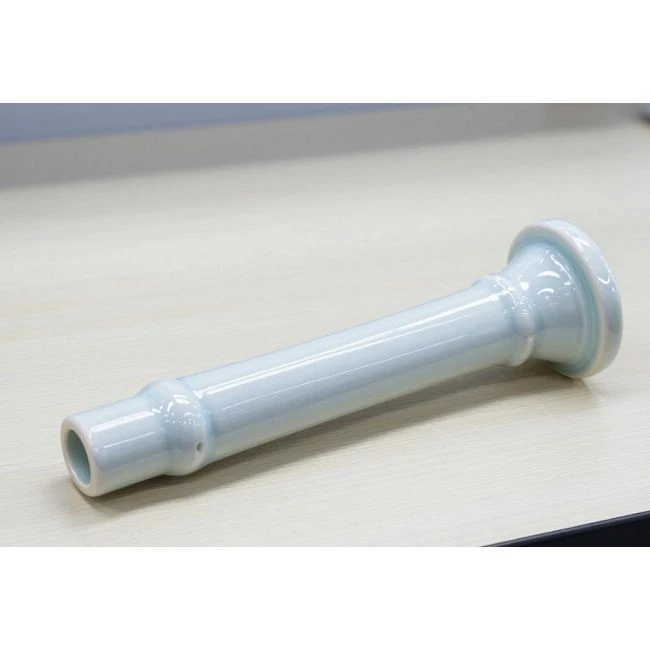
Industrial Ceramic Protection Tubes for Thermocouples
High-Purity Alumina (Al2O3), Mullite, and Silicon Carbide Sheaths for Extreme Thermal Environments
Technical Overview & Material Specifications
Accurate temperature telemetry in aggressive industrial processing depends on the structural integrity of the primary sensor sheath. Our industrial ceramic tubes shield thermocouple assemblies from direct flame impingement, corrosive combustion gases, slag, and mechanical stress at operating limits up to 1800°C.
Manufactured under strict ISO 9001:2015 quality protocols, production utilizes precision slip casting, extrusion, and cold isostatic pressing (CIP), followed by high-temperature tunnel kiln sintering to achieve complete densification and gas-tightness conforming to ASTM C799 and DIN EN 60672 (C799 / C7.10) specifications.
Standard Material Grades
|
Material Grade & Specification |
Purity / Composition |
Max. Operating Temp. |
Key Characteristics & Typical Applications |
|
Alumina (Al2O3) C799 (DIN EN 60672) |
>= 99.3% |
1700 deg C - 1800 deg C |
Exceptional chemical inertness, high volume electrical resistivity at elevated temperatures. Applied with noble metal thermocouples (Types B, S, R) in reducing or vacuum atmospheres. |
|
Alumina (Al2O3) C7.10 (DIN EN 60672) |
95% - 99% |
1500 deg C - 1600 deg C |
Optimized balance of thermal shock resistance and mechanical strength. Standard specification for general industrial heat treating furnaces. |
|
Mullite (C610) |
3Al2O3 · 2SiO2 |
1350 deg C - 1500 deg C |
Cost-effective alternative with high thermal shock resistance. Deployed in ceramic kilns, annealing furnaces, and exhaust gas monitoring lines. |
|
Silicon Carbide (SiC) |
Recrystallized / Reaction Bonded |
1500 deg C - 1650 deg C |
High thermal conductivity, superior mechanical impact strength, and wear resistance. Standard for molten non-ferrous metal immersion (aluminum and copper casting). |
Dimensional Tolerances & Customization
Standard metric and imperial outer diameters (OD) range from 6 mm to 50 mm, with continuous lengths up to 2000 mm. Single-bore, double-bore, and multi-bore inner configurations match specific sensor wire layouts.
Outer Diameter (OD) Tolerance: +/- 0.5% or +/- 0.1 mm (whichever is greater; precision centerless ground finishes available for tight-clearance assemblies).
Wall Thickness Control: Maintained via ultrasonic wall thickness screening to prevent localized thermal hot spots and structural wall thinning.
End Geometries: Available as open-open, closed-one-end (hemispherical or flat bottom for optimized thermal response time), or configured with factory-attached mounting flanges.
Manufacturing & Quality Control
Achieving consistent ceramic density requires tight control over raw material particle sizing and thermal profiles. Production parameters include:
Raw Materials: Micronized oxide powders with engineered particle size distribution to eliminate micro-voids during compaction.
Forming Processes: Hydraulic extrusion and cold isostatic pressing (CIP) up to 200 MPa to ensure green body homogeneity and eliminate density gradients.
Sintering Operations: Gas-fired and electric tunnel kilns operating at peak temperatures up to 1850 deg C with optimized dwell times to achieve full densification (apparent porosity < 0.1% for C799 Alumina).
Inspection Protocols:
- Dye Penetrant Testing: Surface crack and micro-fissure screening on sintered tubes.
- Gas Permeability Testing: Helium leak testing executed on statistical batch samples to verify gas-tightness under vacuum and high-pressure differentials.
- Dimensional Sorting: Automated laser micrometers verify straightness, ovality, and concentricity.
Application Matching Guide & Long-Tail Sourcing Scenarios
Selecting the proper sheath material prevents premature sensor failure and operational downtime.
Vacuum Furnaces & Heat Treating: For applications requiring protective tubes for high-temperature industrial furnaces, use high-purity 99.3% Alumina (C799). Silica impurities in lower-grade oxides volatilize under high vacuum conditions, chemically reducing platinum thermocouple wires and degrading element calibration.
Aluminum Foundries & Non-Ferrous Casting: For operations requiring alumina ceramic well tubes for thermocouple immersion or molten metal processing, apply Silicon Carbide (SiC) or nitride-coated dense alumina to resist wetting and chemical attack from dross and flux salts.
Waste Incineration & Boiler Flues: Utilize Mullite or high-alumina tubes paired with secondary outer metallic support tubes to withstand sulfurous acid gases and fly-ash erosion.
Frequently Asked Questions
Q: What is the operational difference between 95% Alumina and 99.3% Alumina sheaths?
A: 95% Alumina contains minor glass phases that lower manufacturing costs and enhance thermal shock resistance, fitting applications up to 1500 deg C. 99.3% Alumina (C799) minimizes silica and alkali content, preventing chemical poisoning of platinum-rhodium thermocouple elements (Types R, S, B) at temperatures exceeding 1600 deg C.
Q: How do you mitigate thermal shock cracking in ceramic protection tubes?
A: Thermal shock resistance is governed by thermal expansion, thermal conductivity, and tensile strength. For processes with rapid temperature fluctuations, pre-heating protection tubes or substituting high-purity alumina with Mullite or Silicon Carbide variants helps prevent catastrophic fracture.
Q: Can you manufacture custom lengths or integrate mounting flanges?
A: Yes. Custom geometries are produced from engineering drawings or CAD files. Factory-sealed metal-to-ceramic assemblies and specialized mounting flanges (ANSI, DIN, or custom threads) are available upon review.
Q: What is the standard lead time for prototype and production orders?
A: Standard catalog configurations ship within 7 to 10 business days. Custom engineered components require 3 to 4 weeks, covering tooling preparation, forming, sintering, and dimensional quality verification.
Request Technical Datasheet or Quote
To receive complete material test reports (MTR), standard dimension charts, or discuss custom OEM specifications with our engineering team, submit parameters below.
Email for Technical RFQs: [Insert Professional Email]
Sample Program: Qualified industrial OEMs may request trial sample tubes for thermal endurance testing.
Hot Tags: thermocouple ceramic sheath tubes, China thermocouple ceramic sheath tubes manufacturers, suppliers, factory


