

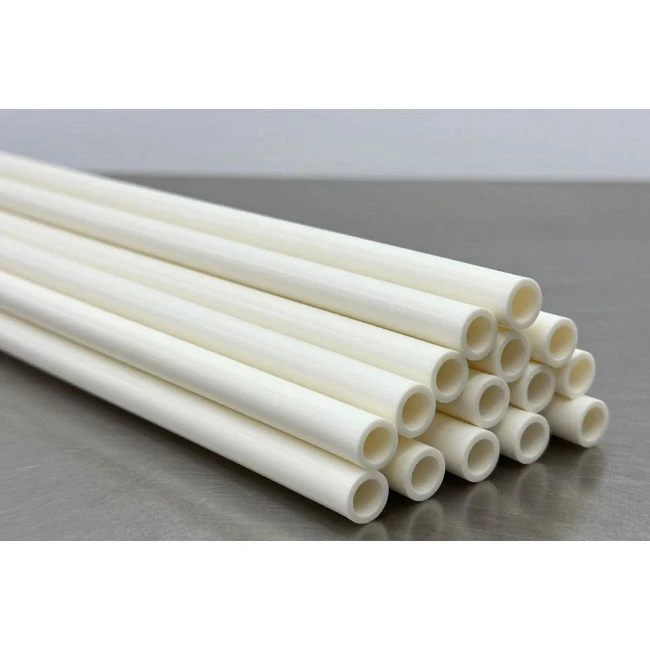
Silicon Carbide (SiC) Ceramic Protection Tubes for Extreme Thermal & Corrosion Environments
Product Selection & Material Grades
Selecting the correct SiC grade prevents premature thermal fatigue and chemical degradation when paired with noble or base-metal thermocouples. Review the material properties below to match your operational parameters.
|
Property / Parameter |
RBSiC / SiSiC (Reaction Bonded) |
NSiC (Nitride Bonded) |
SSiC (Sintered) |
|
Primary Matrix Phase |
SiC + Free Silicon (10-15%) |
SiC + Silicon Nitride (Si3N4) |
Pure Silicon Carbide (>98%) |
|
Max. Operating Temp |
1380°C |
1450°C - 1500°C |
1600°C |
|
Density (g/cm³) |
>= 3.02 |
>= 2.55 |
>= 3.10 |
|
Apparent Porosity |
< 0.1% |
< 10% |
< 0.1% |
|
Flexural Strength (20°C) |
250 MPa |
140 MPa |
400 MPa |
|
Thermal Conductivity |
100 W/m·K |
20 W/m·K |
120 W/m·K |
|
Molten Aluminum Resistance |
Excellent (non-wetting) |
Good |
Excellent |
Technical Specifications & Customization
Standard dimensions are maintained in stock for rapid prototyping and replacement cycles. Custom configurations are machined per engineering drawings.
Outer Diameter (OD): 15 mm to 120 mm (Tolerance: ±0.1 mm)
Inner Diameter (ID): 8 mm to 100 mm (Concentricity deviation < 0.5 mm)
Maximum Length: Up to 2200 mm (Single piece; segmented options available for longer spans)
End Configurations: Closed-end (one-end sealed), open-end, flanged, or threaded metallic adapter joints.
Straightness Tolerance: < 1.5 mm per 1000 mm length (critical for long-insertion furnace tubes).
Industrial Application Areas
Molten Aluminum & Non-Ferrous Metal Processing
- Application: Immersion thermocouple protection in holding furnaces, melting furnaces, and launder troughs.
- Performance Advantage: High density prevents aluminum penetration and zinc vapor attack. Eliminates iron contamination common in metallic thermowells.
High-Temperature Kilns & Heat Treatment
- Application: Radiant heater protection tubes and thermocouple shields in roller hearth, pusher, and vacuum furnaces.
- Performance Advantage: Withstands rapid thermal cycling during loading and unloading without micro-cracking.
Waste Incineration & Power Generation
- Application: Flue gas temperature monitoring and corrosive gas sampling probes.
- Performance Advantage: Resists sulfidation, oxidation, and abrasive fly ash erosion at elevated temperatures.
Manufacturing Process & Quality Control
Reliable performance begins with raw material control and densification precision.
Powder Preparation: High-purity sub-micron SiC powder mixed with precision carbon and silicon infiltrants.
Forming: Isostatic pressing (CIP) and slip casting utilized depending on aspect ratio and wall thickness uniformity requirements.
Firing / Infiltration: Controlled-atmosphere reaction sintering furnaces operating above the melting point of silicon (1414°C).
Dimensional Machining: Diamond grinding to achieve tight tolerances on outer diameters and sealing surfaces.
Quality Inspection Protocol:
- Dimensional Verification: Laser micrometer scanning for outer diameter and straightness.
- Leak Testing: Helium mass spectrometer leak detection for closed-end tubes.
- Microstructural Analysis: SEM examination to ensure complete silicon infiltration and zero residual internal voids.
Frequently Asked Questions
Q: What is the maximum service life of a SiSiC sheath tube in molten aluminum?
A: Service life depends on alloy composition, dross maintenance, and temperature fluctuations. In standard aluminum holding furnaces (700°C–750°C), properly maintained RBSiC tubes typically achieve 12 to 24 months of continuous operation, significantly outperforming metallic protection tubes which fail due to iron dissolution.
Q: Can SiC sheath tubes withstand thermal shock when inserted directly into a hot furnace?
A: Yes. Silicon carbide exhibits an extremely low coefficient of thermal expansion (approx. 4.5 x 10^-6 / K) and high thermal conductivity. RBSiC and SSiC tubes can be inserted directly into operating furnaces up to 1300°C without preheating, though gradual preheating is recommended for lengths exceeding 1500 mm to prevent mechanical stress on mounting flanges.
Q: What sealing methods are recommended between the ceramic tube and the metal furnace flange?
A: We recommend high-temperature ceramic fiber packing combined with a spring-loaded stainless steel compression gland. This accommodates the differential thermal expansion between the ceramic tube and the steel furnace shell while maintaining gas-tight integrity.
Q: Are custom lengths and closed-end designs available without high tooling costs?
A: Yes. For standard diameters (e.g., OD 28mm, 32mm, 45mm), we utilize universal tooling profiles and cut-to-length green machining, allowing custom lengths from 300mm to 2000mm without custom mold fees.
Request a Technical Quotation
To provide an accurate engineering evaluation and commercial quotation, please supply the following parameters in your inquiry:
Operating Environment: (e.g., Molten Aluminum, Slag, Flue Gas, Air)
Maximum Operating Temperature: (°C)
Dimensions: Outer Diameter, Inner Diameter, and Total Length (mm)
End Type: Closed-end or Open-end
Estimated Annual Quantity:
Hot Tags: silicon carbide ceramic sheath tubes, China silicon carbide ceramic sheath tubes manufacturers, suppliers, factory


