

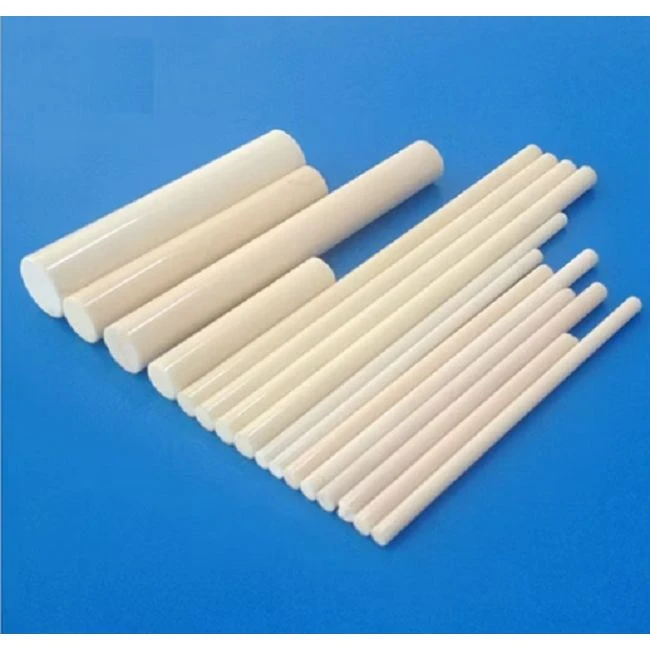
Industrial Alumina Ceramic Rods
Product Identification & Material Grades
Alumina (Al2O3) ceramic rods are dense, rigid structural components designed to withstand extreme thermal, electrical, and mechanical loads where conventional metals and polymers fail.
We supply two primary purity grades tailored to specific operational thresholds:
|
Property / Parameter |
95% Alumina (Al2O3) |
99.8% Alumina (Al2O3) |
|
Density (g/cm3) |
>= 3.65 |
>= 3.90 |
|
Max Working Temp (°C) |
1450 °C |
1750 °C |
|
Flexural Strength (MPa) |
300 - 320 |
380 - 420 |
|
Dielectric Strength (kV/mm) |
15 - 18 |
> 22 |
|
Thermal Conductivity (W/m.K) |
20 - 25 |
30 - 35 |
|
Primary Use Case |
General electrical insulation, mechanical wear pins |
High-temp furnace tubes, semiconductor plasma environments |
Selection Guide: How to Specify Your Alumina Rod
Selecting the correct ceramic rod prevents premature structural failure. Evaluate these four parameters before issuing an RFQ:
Diameter & Length Tolerances: As-fired surfaces have higher variance (plus/minus 1%). For precision assemblies, specify centerless ground rods with tolerance classes down to plus/minus 0.01 mm.
Thermal Shock Resistance: 99.8% alumina offers higher thermal conductivity, mitigating stress under rapid temperature fluctuations. Avoid direct flame impingement unless preheated.
Surface Finish (Ra): Standard ground rods achieve Ra 0.8 um. Polished grades achieve Ra 0.2 um for applications requiring minimal friction or particle generation in cleanrooms.
End Configurations: Standard stock features flat, square-cut ends. Custom configurations include chamfered edges, axial through-holes, stepped diameters, and threaded ends.
Application Verification
These components are engineered for integration into specific industrial systems:
Thermal Processing: Acting as thermocouple protection tubes, radiant heater support rods, and kiln furniture elements operating up to 1750 °C.
Semiconductor & Electronics: Serving as lift pins, plasma chamber insulation standoffs, and high-voltage feedthrough shafts requiring high electrical resistivity under vacuum.
Mechanical & Fluid Control: Utilized as wear-resistant guide shafts, pump plunger rods, and valve components handling abrasive slurries or corrosive acids.
Manufacturing Process & Quality Control
Our production workflow ensures batch-to-batch consistency for OEM integration:
Raw Material Preparation: Spray-dried alumina powder with controlled particle size distribution to eliminate internal voids and sintering defects.
Forming Techniques:
- Isostatic Pressing: Used for large diameter rods, ensuring uniform density distribution.
- Extrusion: Utilized for long, continuous rod geometries.
- Sintering: Fired in high-temperature gas and electric kilns at temperatures exceeding 1600 °C, achieving theoretical density above 98%.
- Precision Machining: Diamond wheel grinding, ultrasonic machining, and laser-assisted profiling to meet tight geometrical tolerances (straightness within 0.05 mm / 100 mm).
Inspection & Testing:
- Dimensional verification via laser micrometers and coordinate measuring machines (CMM).
- Dye penetrant testing for surface micro-cracks.
- Dielectric breakdown voltage testing per ASTM D149.
Supplier Evaluation Matrix (Why Source From Us)
|
Engineering Requirement |
Our Capability |
|
Custom Tooling / Prototypes |
In-house diamond tooling enables rapid sampling without high upfront mold costs. |
|
Material Traceability |
Each shipment includes a Material Test Report (MTR) verifying chemical purity via XRF analysis. |
|
Batch Consistency |
Controlled shrinkage rates (plus/minus 0.2%) verified per sintering lot to ensure drop-in replacement. |
|
Export Logistics |
Custom export-grade crating utilizing high-density EVA foam inserts to eliminate transit breakage. |
Frequently Asked Questions
Q: What is the maximum length and diameter you can manufacture?
A: For extruded rods, diameters range from 2 mm to 50 mm with lengths up to 1500 mm. For isostatically pressed rods, diameters up to 250 mm can be processed. Contact our engineering team for oversized custom requests.
Q: Can alumina ceramic rods be joined to metals?
A: Yes. Common methods include mechanical shrink-fitting, brazing using active metal filler metals (Ti-Ag-Cu alloys), and high-temperature ceramic adhesives. Thermal expansion mismatch (8.0 x 10^-6 / K for alumina vs. stainless steel) must be factored into the joint design.
Q: What is your standard lead time for custom dimensions?
A: Prototyping takes 10 to 15 business days using in-stock green blanks. Mass production orders (quantities > 1,000 pcs) typically require 3 to 4 weeks, depending on grinding complexity and batch size.
Q: Do you provide material test certificates with shipments?
A: Yes. Every batch ships with a Certificate of Analysis (CoA) detailing exact purity percentage, density verification, and dimensional inspection reports verified by XRF and CMM testing.
Request a Quote / RFQ Submission Guide
To receive an accurate technical quotation within 24 hours, please provide the following details in your inquiry:
Grade Requirement: 95% Alumina or 99.8% Alumina.
Dimensions: Outer Diameter (OD), Inner Diameter (ID if tubular), and Overall Length. Include tolerance limits.
Quantity: Prototype batch size vs. annual forecasted volume.
Application Environment: Maximum operating temperature, chemical exposure, and mechanical load requirements.
Drawing File: Attach a 2D/3D CAD drawing (PDF, STEP, or DWG format).
Hot Tags: alumina ceramic rods, China alumina ceramic rods manufacturers, suppliers, factory, ceramic electronic assembly part, ceramic guide block, ceramic guide pin, ceramic insulating pin, ceramic mechanical insulator, ceramic mechanical spacer


