

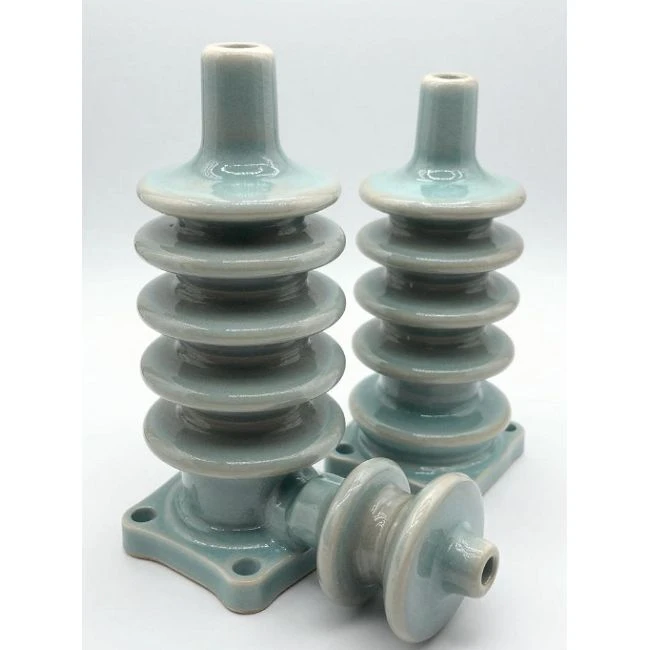
Custom & Standard Electrical Ceramic Insulators for Industrial OEM & Power Systems
Precision-engineered ceramic insulators designed to withstand high-voltage, extreme temperatures, and severe mechanical loads. Manufactured via dry-pressing, isostatic pressing, and wet extrusion under strict ISO 9001:2015 quality systems and RoHS/REACH compliance directives.
Technical Specifications & Material Grades
Material selection determines dielectric strength, thermal shock resistance, and load-bearing capacity. Review our standard industrial engineering grades below:
|
Material Grade |
Alumina (Al2O3) Content |
Dielectric Strength (kV/mm) |
Max Operating Temp (deg. C) |
Flexural Strength (MPa) |
Primary Industrial Application |
|
C795 (High Alumina) |
95% - 99% |
> 18 |
1600 |
300 - 350 |
Vacuum interrupters, high-frequency induction heating fixtures |
|
C110 (Electrical Porcelain) |
50% - 60% |
> 12 |
1000 |
90 - 110 |
Outdoor distribution switchgear, line post insulators |
|
Cordierite / Mullite |
Low (Silicate-based) |
> 10 |
1200 - 1300 |
80 - 100 |
Heating element supports, thermal shock-resistant furnace parts |
Manufacturing & Quality Control Architecture
Consistent electrical performance begins with strict shop-floor process control:
Powder Preparation: Wet ball-milling and industrial spray drying to achieve homogeneous particle size distribution and eliminate internal voids.
Forming Methodologies:
- Dry Pressing: Optimized for high-volume, uniform geometric shapes (washers, small bushings, modular blocks).
- Isostatic Pressing: Applied to complex, high-voltage components requiring isotropic density and zero internal stress.
- Extrusion: Utilized for long rods, tubes, and symmetrical cylindrical profiles.
- Sintering (Kiln Firing): Controlled tunnel and shuttle kilns operating up to 1750 deg. C, utilizing automated oxygen and temperature profiling to ensure full vitrification and zero open porosity.
- Precision Machining: CNC diamond grinding and ultrasonic drilling for features requiring strict mating tolerances.
Quality Assurance & Testing Protocols:
- 100% High-Voltage Dielectric Withstand Testing: Performed on production batches prior to shipment.
- Dye Penetrant Inspection: For micro-crack and surface defect detection.
- Thermal Shock Testing: Accelerated cycling (20 deg. C to 800 deg. C) to verify structural thermal endurance.
Application Matrix
Power Transmission & Distribution: Busbar supports, transformer bushings, and high-voltage switchgear stand-offs.
Industrial Thermal Systems: Heating element mandrels, thermocouple protection sheaths, and furnace standoff blocks.
Electrical Equipment OEM: Arc chutes, vacuum circuit breaker components, and high-temperature insulation spacers.
Compliance & Sourcing Assurance
Full Traceability: Complete lot tracking from raw mineral batch to finished ceramic component, backed by Material Test Reports (MTRs).
Regulatory Compliance: 100% compliant with EU RoHS and REACH directives regarding hazardous substances.
International Standards: Manufactured and tested in accordance with IEC 60672, ASTM D150, and ANSI C29.
Engineering Collaboration: In-house ceramic application engineers available to evaluate CAD models, optimize draft angles, and advise on shrinkage behavior.
Frequently Asked Questions
Q: What is the standard lead time for custom ceramic components?
A: Tooling development and prototype sampling typically require 3 to 4 weeks. Full-scale production runs generally take 4 to 6 weeks, depending on geometric complexity and secondary grinding requirements.
Q: Do you offer glazed finishes, and what are their benefits?
A: Yes. We provide standard brown and white electrical glazing. Glazing seals surface micro-pores, increases mechanical tensile strength by up to 15%, and prevents moisture accumulation in humid or outdoor operational environments.
Q: What CAD file formats do you accept for RFQs?
A: We accept STEP, IGES, SolidWorks (.sldprt), and PDF drawings complete with explicit geometric tolerances and surface finish callouts.
Q: How do you account for firing shrinkage during tooling design?
A: Technical ceramics experience 12% to 18% linear shrinkage during high-temperature sintering. Our tooling engineering team applies proprietary mathematical shrinkage compensation algorithms tailored to specific body formulations to maintain final dimensions within +/- 1% or +/- 0.05 mm via post-firing grinding.
Q: Can you provide compliance documentation for audits?
A: Yes. Material Test Reports (MTRs), ISO 9001 certificates, and RoHS/REACH declarations of conformity can be provided upon request.
Request a Technical Quote
To enable our engineering team to provide a rapid and accurate evaluation, please provide the following details:
- 2D/3D technical drawing with critical dimensions and tolerances.
- Operating environment metrics (working voltage, maximum operational temperature, mechanical load vectors).
- Estimated Annual Usage (EAU) or required batch quantities.
Hot Tags: electrical ceramic insulators, China electrical ceramic insulators manufacturers, suppliers, factory, alumina ceramic bushing, alumina ceramic spacer, ceramic bushing sleeve, ceramic guide block, ceramic insulating fitting, ceramic tube connector sleeve


