

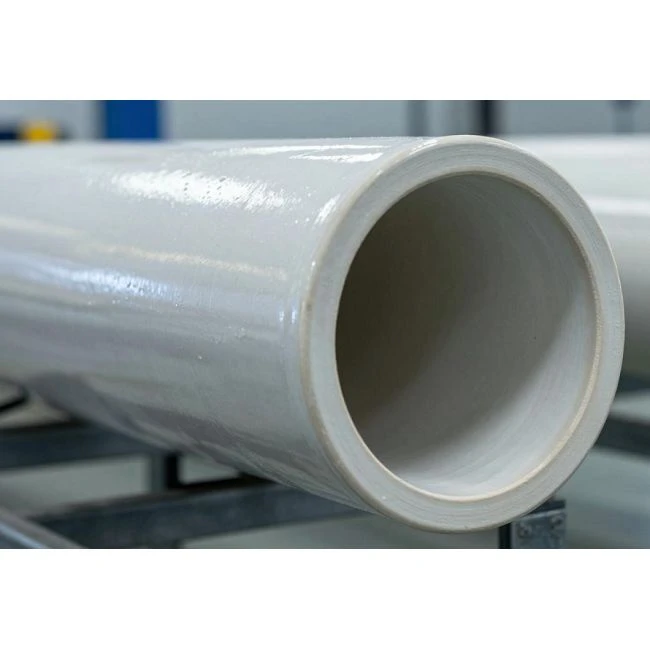
Gas-Tight Ceramic Sheath Tubes: Technical Specification & Engineering Guide
Product Identification & Material Standards
Gas-tight ceramic sheath tubes act as the frontline barrier protecting thermocouples, heating elements, and gas-sampling probes from corrosive process gases, mechanical impact, and oxidation at extreme temperatures.
Unlike porous refractory tubes, true gas-tight tubes require a fully densified crystalline microstructure achieved through high-temperature firing (sintering) above 1750°C.
Material Grade Comparison
|
Property / Parameter |
99% Alumina (AL-99) |
99.7% Recrystallized Alumina (AL-99.7) |
Recrystallized Silicon Carbide (R-SiC) |
|
Max. Operating Temp |
1600°C |
1800°C |
1650°C |
|
Alumina Purity |
>= 99.0% |
>= 99.7% |
N/A (SiC >= 98%) |
|
Open Porosity |
0% (Gas-tight) |
0% (Gas-tight) |
< 0.1% |
|
Density |
3.80 g/cm3 |
3.90 g/cm3 |
2.70 g/cm3 |
|
Flexural Strength (20°C) |
300 MPa |
350 MPa |
250 MPa |
|
Thermal Conductivity (1000°C) |
10 W/m*K |
12 W/m*K |
25 W/m*K |
Product Selection Guide
When configuring a ceramic sheath tube for your system, engineers must evaluate four critical mechanical and thermal vectors:
Outer Diameter (OD) & Inner Diameter (ID): Standard OD ranges from 6 mm to 50 mm, with wall thicknesses typically between 1.5 mm and 5 mm. Ensure sufficient clearance for dual-element or heavy-gauge thermocouple wires.
Length & Straightness Control: Standard lengths range up to 2000 mm. For lengths exceeding 1000 mm, total indicator reading (TIR) straightness is maintained within < 1.5 mm per meter to prevent binding during horizontal furnace insertion.
End Configurations:
- One end closed, one end open (Standard thermocouple well configuration).
- Both ends open (For gas sampling, radiant heater protection, or tube furnace liners).
- Glazed vs. Unglazed: Unglazed surface is standard for high-temp purity; optional high-temperature ceramic glaze on the cold end for enhanced sealing.
Application & Process Compatibility
Gas-tight ceramic tubes are specified across heavy thermal processing sectors where baseline metals (Inconel, Kanthal) fail due to oxidation or chemical attack:
Thermocouple Protection in Atmosphere Furnaces: Protects Type B, S, and R noble metal thermocouples in carburizing, nitriding, and reducing atmospheres (hydrogen/nitrogen mix) up to 1700°C.
Semiconductor Crystal Growth: Used in high-purity crystal pullers (Cz method) and tube furnaces where volatile impurities from lower-grade ceramics would ruin semiconductor wafers.
Glass & Metallurgy Melt Monitoring: Immersed in molten zinc, aluminum, or glass tank exhaust ports to withstand corrosive slag and thermal corrosion.
Manufacturing Process & Quality Control
Reliability in thermal processing begins at the raw material preparation stage. Our production workflow eliminates structural flaws before firing:
Dry Pressing & Cold Isostatic Pressing (CIP): Small tubes (OD < 25 mm) are precision extruded; large or thick-walled tubes undergo CIP at 200 MPa to ensure uniform density distribution and eliminate micro-voids.
High-Temperature Tunnel Kiln Sintering: Fired in gas/electric tunnel kilns at temperatures up to 1800°C, promoting crystal grain growth and complete pore closure.
Rigorous Inspection Protocols:
- He-Leak Testing (Helium Mass Spectrometry): 100% batch sampling tested to ensure leak rates of < 10^-9 Pa*m3/s under vacuum conditions.
- Dimensional & Straightness Check: Laser-guided optical comparators verify outer diameter, wall thickness uniformity, and axial straightness.
- Dye Penetrant Testing: Detects surface micro-cracks induced during diamond machining of custom flanges or threads.
Supplier Evaluation Matrix
|
Evaluation Criteria |
Supplier Benchmark |
What to Request / Verify |
|
Raw Material Traceability |
Certified powder batches (e.g., Almatis, Baikowski precursors) |
Material Test Report (MTR) showing exact SiO2, Fe2O3 trace impurity levels. |
|
Process Capability |
In-house CIP pressing and multi-zone high-temp kilns |
Factory audit reports confirming kiln temperature uniformity (+/- 2°C). |
|
Batch Consistency |
Statistical Process Control (SPC) on shrinkage and density |
Certificate of Analysis (COA) supplied with every production lot. |
|
Packaging & Logistics |
Custom shock-absorbing crating (honeycomb foam & export-grade wooden crates) |
Transit breakage rate history (< 0.5% target for international freight with drop-test validation). |
Frequently Asked Questions
Q: What causes ceramic protection tubes to crack during initial furnace heat-up?
A: Thermal shock failure typically occurs when the heating rate exceeds the material's thermal dissipation limit. For 99.7% alumina tubes, we recommend ramping furnace temperature at no more than 150°C to 200°C per hour below 600°C, where alumina is more susceptible to thermal stress. Pre-heating the tube near the furnace entrance zone before full insertion is standard operational practice.
Q: Can these tubes withstand direct contact with molten metals?
A: 99.7% Alumina exhibits high corrosion resistance against molten aluminum, zinc, and certain steel slags, but it will react chemically with molten reducing metals (such as titanium or active silicon). For aggressive molten metal immersion, verify chemical compatibility charts prior to specification.
Q: What is the typical lead time for custom dimensions or flanged tubes?
A: Standard catalog tubes (OD <= 30 mm, length <= 1200 mm) are stocked in standard quantities for immediate shipment. Custom dimensions requiring dedicated tooling or diamond grinding have a standard manufacturing cycle of 3 to 4 weeks.
Technical Resources & Inquiry
Engineering CAD / PDF Downloads: Request verified 2D/3D model drawings and detailed material safety datasheets for standard dimensions directly through our engineering support channel.
To supply an accurate engineering proposal or testing samples for your thermal system, please provide the following parameters in your inquiry:
Operating Temperature & Atmosphere Type (e.g., Vacuum, Air, Hydrogen, Carburizing)
Inner Diameter, Outer Diameter, and Overall Length Requirements
Target Quantity per Order and Annual Forecast
Hot Tags: gas-tight ceramic sheath tubes, China gas-tight ceramic sheath tubes manufacturers, suppliers, factory


