

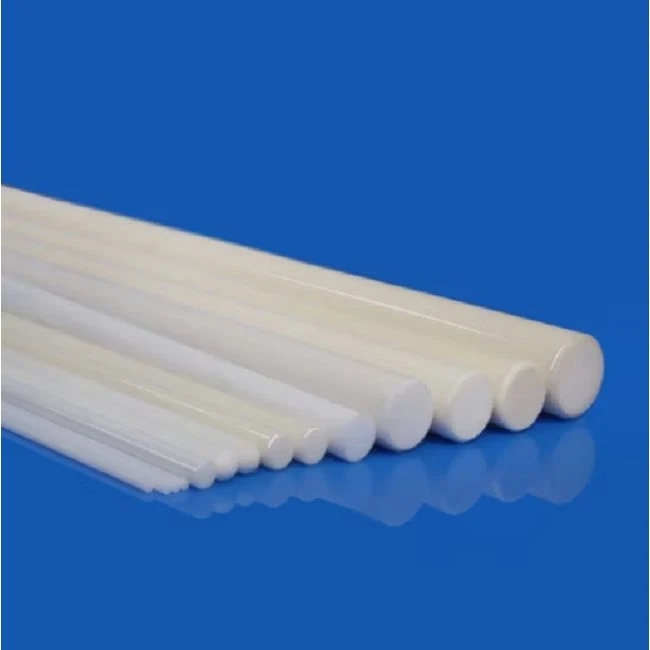
High-Precision Technical Ceramic Rods
Custom-Engineered Alumina, Zirconia, & Silicon Nitride Rods for Demanding Industrial Environments
Product Overview & Material Matrix
Precision ceramic rods serve as structural, wear-resistant, and thermally stable components in high-stress industrial applications. Standard stock materials include 95% to 99.8% Alumina (Al2O3), Yttria-Stabilized Zirconia (Y-TZP), and Hot-Pressed Silicon Nitride (Si3N4).
|
Material Grade |
Purity / Composition |
Max Temp (°C) |
Flexural Strength (MPa) |
Fracture Toughness (MPa·m1/2) |
Primary Application Focus |
|
Alumina (99.8%) |
Al2O3 >= 99.8% |
1600 |
350 - 450 |
3.5 - 4.0 |
Electrical insulation, semiconductor fixtures, wear resistance. |
|
Zirconia (Y-TZP) |
ZrO2 + Y2O3 |
1000 |
900 - 1200 |
6.0 - 8.0 |
High impact shafts, valve plungers, extreme wear guides. |
|
Silicon Nitride |
Si3N4 |
1000 |
700 - 900 |
6.0 - 7.0 |
Thermal shock resistance, high-speed rotating shafts, bearings. |
Product Selection & Dimensional Capabilities
Meeting strict assembly clearances requires tight post-sintering diamond grinding and lapping.
Diameter Range: 0.5 mm to 150 mm
Length Range: Up to 1200 mm (depending on diameter and material aspect ratio)
Standard Dimensional Tolerance: Down to +/-0.001 mm (achieved via centerless grinding)
Surface Roughness: Ra <= 0.1 um (mirror finish available upon request)
Straightness / Camber: <= 0.01 mm per 100 mm
Application & Environment Matching
Selecting the correct rod grade depends on operating stressors:
Semiconductor Processing Chambers: 99.8% Alumina rods provide zero outgassing, high plasma corrosion resistance, and stable electrical resistivity at temperatures up to 1500°C.
Automated Assembly Guide Pins: Y-TZP Zirconia rods absorb mechanical impact and resist abrasive wear against metal mating surfaces due to transformation toughening.
Thermal Cycling Environments: Silicon Nitride rods maintain structural integrity during rapid thermal quenching due to a low thermal expansion coefficient and high thermal shock parameter (R).
Manufacturing Process & Quality Control
Internal fabrication control spans green machining, controlled-atmosphere sintering, and precision finishing.
Forming Methods: Cold Isostatic Pressing (CIP) for high-density blanks, dry pressing for high-volume standard components, and slip casting for complex geometries.
Sintering: Programmable gas-fired and vacuum kilns with micro-processor temperature profiles to eliminate internal micro-voids and ensure theoretical density (>= 99.2%).
Precision Machining: CNC creep-feed surface grinders, diamond wire saws, and ultrasonic machining centers equipped with in-situ laser micrometers.
Inspection Protocol:
- 100% laser OD and length screening.
- Fluorescent dye penetrant inspection for surface micro-cracks.
- Coordinate Measuring Machine (CMM) for geometric tolerance verification.
- Material Test Reports (MTR) supplied with every batch confirming density and purity.
Frequently Asked Questions
Q: What is the maximum length-to-diameter ratio achievable for precision ceramic rods?
A: For Alumina and Zirconia, the recommended maximum aspect ratio is 25:1 to maintain straightness during centerless grinding. Higher ratios require specialized fixture support during machining and are evaluated on a per-drawing basis.
Q: How do you control shrinkage variation during the sintering phase?
A: Linear shrinkage ranges from 16% to 22% depending on the raw powder formulation and green density. Sintering shrinkage tables are applied dynamically per powder lot, followed by post-sintering diamond grinding to hit final print tolerances.
Q: Can ceramic rods be supplied with custom ends (threads, slots, or cross-holes)?
A: Yes. Green machining or post-sintering ultrasonic CNC machining enables the fabrication of internal/external threads, cross-drilled holes, flats, and spherical ends per STEP or IGES CAD files.
Q: What documentation is included with commercial shipments?
A: Each shipment includes a Certificate of Conformance (CoC), dimensional inspection sheets, and material composition verification reports traceable to the raw powder batch.
Request a Technical Quote
Submitting an engineering drawing (PDF/STEP) ensures a rapid evaluation of manufacturability, tooling costs, and lead times.
Required RFQ Details: Material grade, quantity per batch, critical functional tolerances, and operating environment parameters (temperature, chemical exposure, load).
Hot Tags: precision ceramic rods, China precision ceramic rods manufacturers, suppliers, factory, alumina ceramic bushing, ceramic abrasion block, ceramic assembly spacer ring, ceramic mounting bracket insert, ceramic mounting insulator, ceramic structural fitting


