

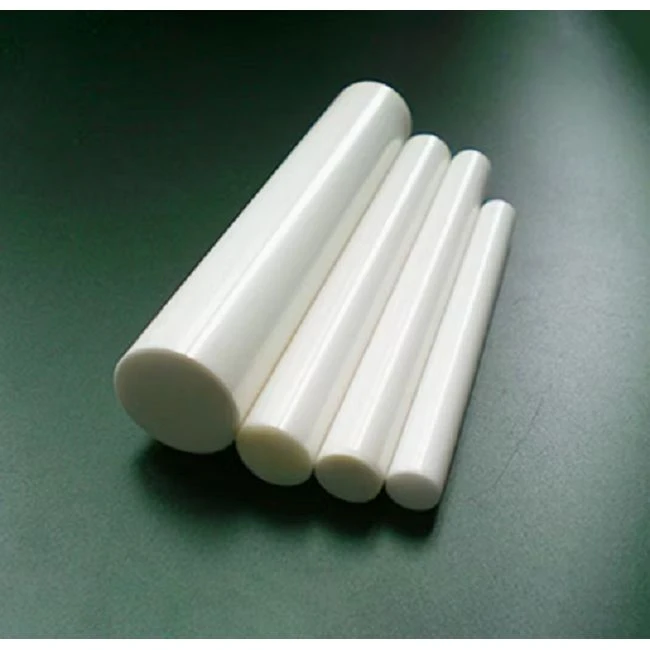
Industrial Wear-Resistant Ceramic Rods: Technical Specs & Sourcing Guide
Product Overview & Core Specifications
Industrial wear-resistant ceramic rods are engineered from high-purity alumina (Al2O3) and zirconia-toughened alumina (ZTA). Replacing conventional hardened steels and metal alloys, they provide extreme resistance to sliding abrasion, particle impact, and chemical corrosion in heavy-duty material handling loops.
Standard Material Grades & Physical Properties
|
Property |
92% Alumina (Al2O3) |
95% Alumina (Al2O3) |
ZTA (Zirconia Toughened) |
|
Density |
>= 3.60 g/cm3 |
>= 3.72 g/cm3 |
>= 4.10 g/cm3 |
|
Vickers Hardness (HV10) |
1080 - 1150 |
>= 1200 |
1300 - 1500 |
|
Flexural Strength |
280 - 320 MPa |
>= 350 MPa |
600 - 800 MPa |
|
Fracture Toughness (KIC) |
3.5 MPa * m^1/2 |
3.8 MPa * m^1/2 |
7.0 - 8.5 MPa * m^1/2 |
|
Max Operating Temp |
1000°C |
1400°C |
800°C |
Product Selection Guide
Selecting the correct ceramic rod requires evaluating operating stress profiles, impact energy, and chemical exposure.
For High Sliding Abrasion (Pneumatic Conveying Liners): Specify 92% Alumina. It offers optimal cost-to-performance for fine particle friction where impact forces are minimal.
For Corrosive Slurries & High-Temperature Environments: Specify 95% Alumina. Higher purity reduces grain boundary impurity degradation in acidic or alkaline wash-down cycles.
For High Impact & Mechanical Stress (Pins, Shafts, Rollers): Specify ZTA (Zirconia Toughened Alumina). The transformation toughening mechanism prevents catastrophic brittle fracture under sudden mechanical shock.
Industrial Application Scenarios
Pneumatic Conveying Systems: Installed as wear-resistant elbows, flow dividers, and impact pins inside ash and cement transport pipelines.
Slurry Pump Components: Utilized as shaft sleeves and seal rings handling abrasive mineral slurries in mining circuits.
Wire and Cable Manufacturing: Deployed as guide pins and capstans where continuous friction destroys standard alloy steel rollers within weeks.
Powder Processing Equipment: Acting as grinding media pins and classifier rotors in fine milling circuits.
Manufacturing Process & Quality Control
Reliable wear life originates from strict powder preparation, cold isostatic pressing (CIP), and high-temperature tunnel kiln sintering (1600°C - 1680°C).
Forming Methods: Dry pressing for high-volume standard rods; Cold Isostatic Pressing (CIP) at 200 MPa for larger diameters to eliminate internal micro-voids.
Precision Machining: Green-state machining followed by diamond wheel grinding and polishing to meet strict geometrical and surface roughness (Ra <= 0.4 um) requirements.
Inspection Protocols:
- Dimensional verification via laser micrometers and coordinate measuring machines (CMM).
- Density and porosity checks via Archimedes water displacement method.
- 100% visual inspection for surface micro-cracks using dye penetrant testing upon request.
Supplier Evaluation & Verification
When auditing a technical ceramic supplier, verify the following baseline capabilities:
In-House Sintering Control: Ensure the supplier operates continuous gas-fired or electric tunnel kilns with closed-loop temperature profiling to prevent uneven shrinkage and warping.
Raw Material Traceability: Request chemical composition assay reports verifying trace impurities (e.g., controlling Fe2O3 below 0.2% to prevent localized phase weakness).
Customization Flexibility: Confirm capability for centerless grinding, threading, or end-slotting based on proprietary engineering drawings (STEP/IGES formats).
Procurement & RFQ Checklist
To receive an accurate technical proposal and commercial quotation within 24 hours, include these parameters in your inquiry:
Material Grade: (e.g., 92% Alumina, 95% Alumina, ZTA)
Dimensions: Outer Diameter (OD), Inner Diameter (if tubular), and Length with exact tolerances.
Application Environment: Operating temperature, abrasive medium type (e.g., silica sand, coal ash), and presence of impact loads.
Quantity: Prototype sample quantity vs. annual blanket order volume.
Quality Documentation: Specify if Material Test Reports (MTR) or third-party SGS inspection certificates are required.
Frequently Asked Questions
Q: What is the typical lead time for custom-sized ceramic rods?
A: Standard catalog items ship within 3 - 5 business days. Custom orders requiring specialized tooling, green machining, and high-temperature sintering typically require 3 - 4 weeks. Expedited prototyping options are available for urgent plant maintenance.
Q: How do you prevent ceramic rods from cracking during metal housing installation?
A: Dimensional precision and tolerance matching are critical. We recommend interference fits controlled within 0.02 - 0.04 mm, combined with high-temperature epoxy resins (200°C - 350°C) or shrink-fit mechanical mounting to distribute thermal expansion stress evenly.
Q: Can ceramic rods be supplied with threaded ends or cross-holes?
A: Yes. While sintered ceramics cannot be traditionally tapped or drilled post-sintering, we machine these features in the green state before high-temperature firing, or use diamond core drilling tools post-sintering for precise blind or through-holes.
Hot Tags: wear-resistant ceramic rods, China wear-resistant ceramic rods manufacturers, suppliers, factory, Alumina Ceramic Rings, Ceramic Disc For Lighters, ceramic insulating pin, ceramic sealing ring, ceramic support insulator, ceramic wear resistant accessory


